Two Roads Cross at a Junction, But at What Angle?
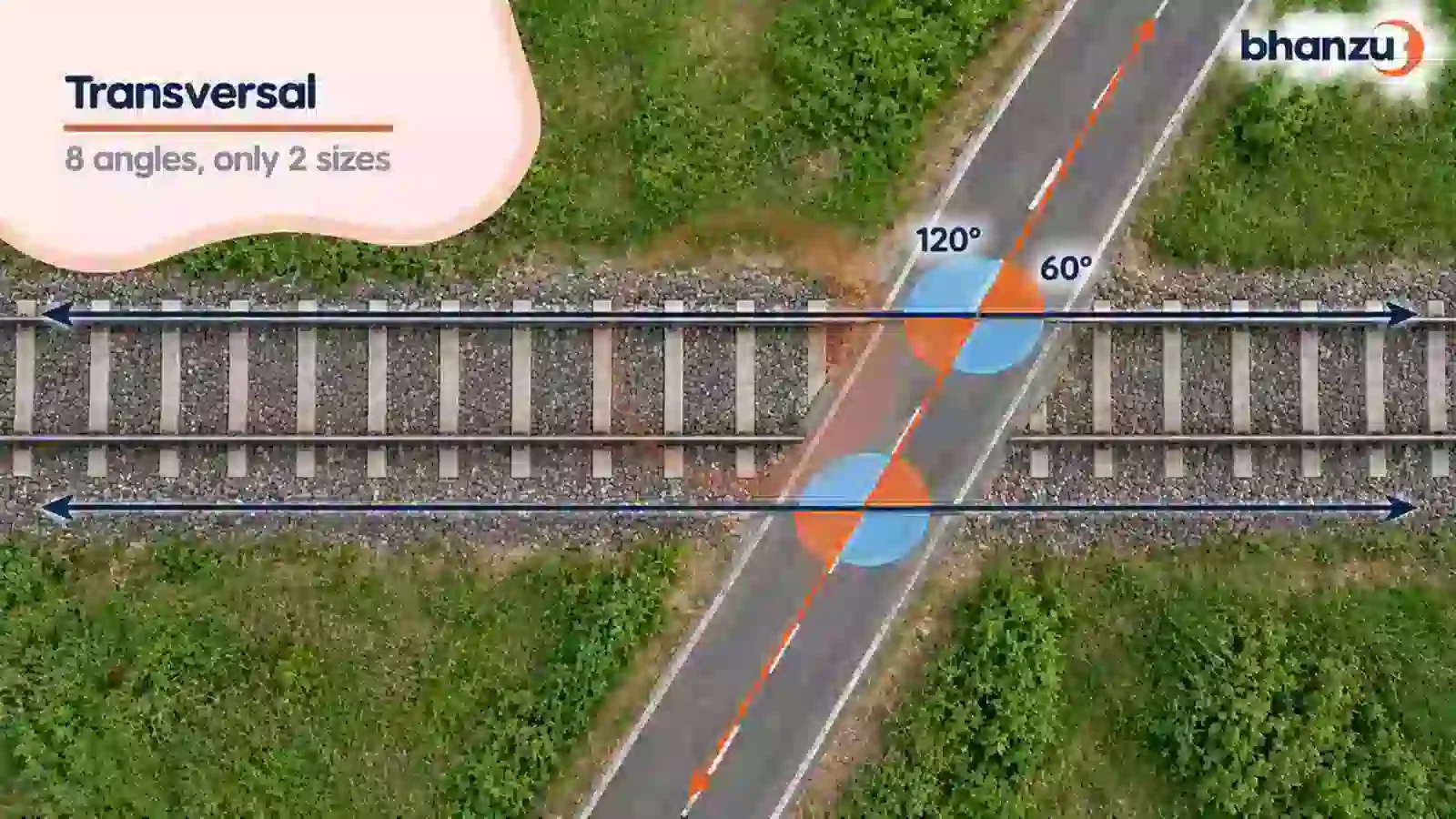
Every time two roads meet, a surveyor has to name the exact angle of the junction, and a single slope value on each road is enough to compute it. That is the whole problem the angle-between-two-lines formula solves: given how steeply two lines climb, find the wedge of space between them.
What Is the Angle Between Two Lines?
The angle between two lines is the measure of the inclination of one line relative to the other, taken at their point of intersection. When two lines cross, they form two pairs of angles, one acute and one obtuse, and by convention the angle between the lines means the acute angle unless a problem states otherwise.
Each straight line makes an angle of inclination with the positive x-axis, and the slope is the tangent of that inclination: . If one line is inclined at and the other at , the angle between them is simply the difference . Taking the tangent of that difference produces the working formula, which is why a couple of slope numbers tell you the whole geometry.
How Do You Find the Angle Between Two Lines?
There are three standard methods, chosen by how the lines are described. Each is the same idea in a different costume, so pick the one that matches the information you are handed.
From two slopes (2D). When you know the slopes and , apply the tangent-of-the-difference identity:
Here and are the two slopes, and the absolute value guarantees θ comes out as the acute angle. The formula is undefined when , which is exactly the perpendicular case.
From two line equations (2D). For lines and , the same angle is:
This avoids solving for slope first, which is handy when a line is vertical and its slope is undefined.
From direction vectors (3D). In three dimensions two lines need not intersect, so the angle is defined through their direction vectors and using the dot product:
The dot-product method also works in 2D and connects the topic to coordinate geometry as a whole. For the underlying identity, Wolfram's Line-Line Angle reference states the same result.
Where Does the Slope Formula Come From?
The derivation is one line of trigonometry. If the inclinations are and with and , then the angle between the lines is , and the tangent subtraction identity gives
Wrapping the right side in absolute value bars selects the acute angle regardless of which line is steeper.
What Are the Conditions for Parallel and Perpendicular Lines?
Two special cases fall straight out of the slope formula, and both are worth memorising because each turns the angle question into a one-line check.
Parallel lines. Parallel lines share an inclination, so their slopes are equal: . Then , which forces and . Equal slopes mean there is no angle between the lines.
Perpendicular lines. When the lines meet at a right angle the denominator vanishes: , so . A zero denominator sends to infinity, which corresponds to .
So the slopes alone classify the pair before any full calculation: equal slopes give , a slope product of gives , and every other case needs the tangent formula.
Examples of Angle Between Two Lines
Example 1
Find the acute angle between two lines with slopes and .
Final answer: .
Example 2 (Wrong path first)
Find the angle between the lines and .
Wrong attempt. A student reads the coefficients and writes , flipping the numerator and denominator. That gives , so . The number looks tidy, but the formula was inverted, so the angle is wrong.
Correct. The slope form is safest here. The slopes are and .
Final answer: . The lines are close to perpendicular, which the wrong path had completely hidden.
Example 3
Find the acute angle between and .
The slopes are and .
Final answer: .
Example 4
Two lines have slopes and . Find the angle between them.
Check the product first: . The denominator , so is undefined.
An undefined tangent means . The lines are perpendicular, matching the slope of perpendicular lines condition.
Final answer: .
Example 5
A line passes through and ; another passes through and . Find the acute angle between them.
First line: .
Second line: .
Final answer: .
Example 6
Find the angle between the 3D lines with direction vectors and .
Dot product: .
Magnitudes: and .
Final answer: .
Why Does the Angle Between Two Lines Matter?
The formula is the quiet workhorse behind anything that measures how two directions differ. When René Descartes fused algebra with geometry, he made it possible to turn a picture of crossing lines into an equation you can compute, and the angle formula is a direct descendant of that idea; his biography at MacTutor traces the origin of coordinate methods.
Where it earns its keep:
Robotics and computer graphics. Collision checks and joint angles come down to the angle between direction vectors, computed with the dot-product form (see the dot product reference).
Civil surveying. Road and rail junctions are specified by the angle at which alignments cross, read straight from their slopes.
Physics. Resolving forces or velocities along two lines of action starts with the angle between those lines.
The reason the acute angle is the standard answer is practical: two crossing lines make an acute and an obtuse angle that add to , and reporting the acute one removes the ambiguity.
What Are the Most Common Mistakes With the Angle Between Two Lines?
Mistake 1: Dropping the absolute value
Where it slips in: computing when the slopes have opposite signs.
Don't do this: leave as a negative number and report a negative angle.
The correct way: keep the absolute value bars. A negative tangent means you found the obtuse angle's supplement; the bars force the acute result. The first instinct is to treat the subtraction order as fixed, but the sign of the difference is exactly what the absolute value is there to absorb.
Mistake 2: Missing the perpendicular special case
Where it slips in: when .
Don't do this: push a zero denominator into a calculator and record "error" as the answer.
The correct way: recognise that means the lines are perpendicular, so . The rusher plugs numbers before checking the product; the pause to test first saves the whole problem.
Mistake 3: Confusing the acute and obtuse angle
Where it slips in: reading an obtuse angle off a diagram and assuming it is "the" angle.
Don't do this: report when the convention wants the acute partner.
The correct way: if a computed angle exceeds , its supplement is the acute angle between the lines. The second-guesser often computes both and then cannot decide; the convention decides for you, take the acute one unless told otherwise.
This same acute-versus-obtuse ambiguity shows up in the real world: air-traffic controllers describing the angle at which two flight paths cross always name the smaller intersection angle, because the larger one carries no extra information and invites error. Understanding how slopes relate also underpins parallel and perpendicular lines, where the angle collapses to or .
Conclusion
The angle between two lines is , returning the acute angle at the intersection.
Three equivalent methods exist: slopes, line coefficients, and 3D direction vectors via the dot product.
Parallel lines give ; perpendicular lines give (where the denominator vanishes).
The most common mistake is dropping the absolute value, which flips a clean acute angle into a wrong sign.
The acute angle is the standard answer whenever two lines cross.
To work through more of these with a teacher, explore Bhanzu's geometry tutor or a high school math tutor, or join structured math classes online.
Practice These to Solidify Your Understanding
Work through these three, then check the slope refresher if any step feels shaky.
Find the acute angle between lines with slopes and .
Find the angle between and .
Find the angle between the 3D lines with direction vectors and .
Want a live Bhanzu trainer to walk through more angle-between-lines problems? Book a free demo class —
Read More
Was this article helpful?
Your feedback helps us write better content
Frequently Asked Questions
Can the angle between two lines be negative?
What is the angle between two parallel lines?
How do you find the angle between two lines in 3D?
Why is there an absolute value in the formula?
What if one line is vertical?