What Are The Special Cases In Linear Equations?
The special cases in linear equations are the three possible results of solving one: one unique solution, no solution, or infinitely many solutions. Most equations you meet have a single answer, and the two others feel surprising the first time, which is exactly why they are worth naming. A linear equation is one where every variable appears only to the first power, so its graph is always a straight line.
The three outcomes are the only ones possible, and each leaves a different fingerprint in the algebra:
One solution: the variable survives the simplification and lands on a single number, such as .
No solution: the variable cancels out and leaves a statement that is false, such as .
Infinitely many solutions: the variable cancels out and leaves a statement that is true, such as .
The same story appears for a pair of equations in two variables. The two lines either cross at one point (one solution), never meet (no solution), or sit exactly on top of each other (infinitely many solutions). The rest of this article shows the algebra for each case, then the quick test for spotting them in a system.
If the idea of solving a single equation is still new, start with solving linear equations and come back.
When Does A Linear Equation Have One Solution?
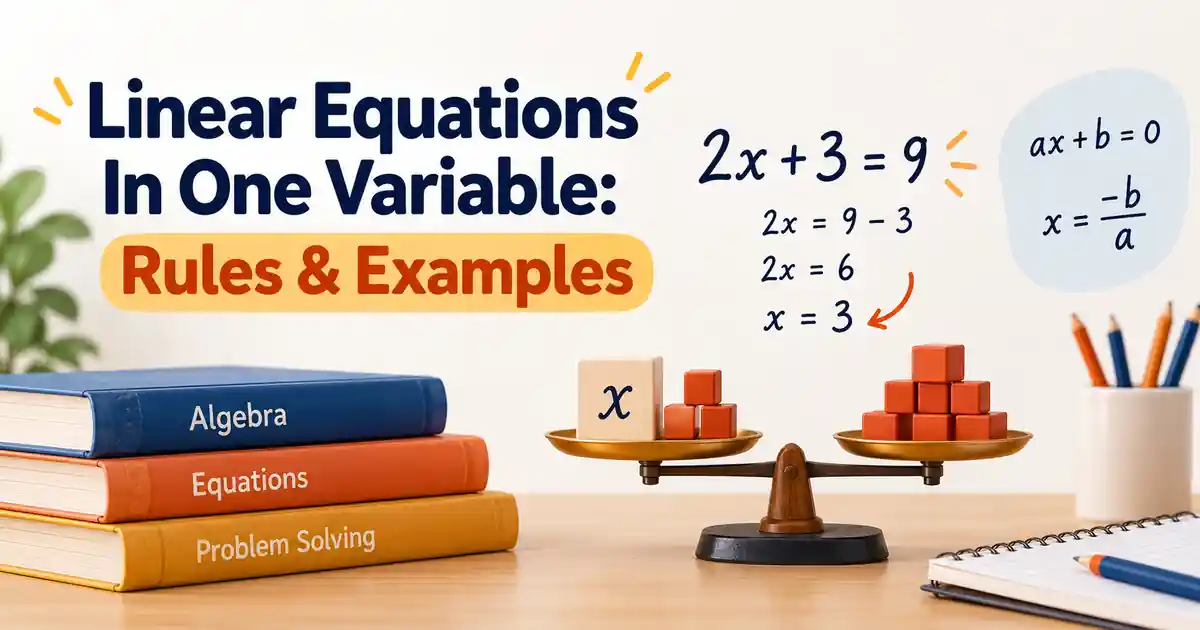
A linear equation has exactly one solution when the variable does not cancel, so you can isolate it and read off a single value. This is the ordinary case, the one that behaves the way most students expect.
Here never disappears. Every step keeps a real term on one side, and the equation ends on a plain number. The value is the only input that makes the two sides equal, which is what "one solution" means.
For a pair of equations, one solution shows up as two lines that cross at a single point. Take and . Adding the equations gives , so and .
The point is the one place both lines pass through. A system like this is called consistent and independent.
When Does A Linear Equation Have No Solution?
A linear equation has no solution when the variable cancels and leaves a false statement. There is no number you could put in to rescue it, so the solution set is empty.
Subtract from both sides:
The term is gone, and is simply not true. No value of can make equal , so the equation has no solution. A false end statement like this is called a contradiction.
In a system, no solution means the two lines are parallel: same steepness, different heights, so they never touch. Consider:
Rewrite each in slope-intercept form. The first gives and the second gives . Both slopes equal , but the intercepts differ, so the lines run parallel and share no point. A system with no solution is called inconsistent.
When Does A Linear Equation Have Infinitely Many Solutions?
A linear equation has infinitely many solutions when the variable cancels and leaves a statement that is always true. Every number is a solution, because both sides were secretly the same expression all along.
Expand the left side:
Subtract from both sides:
The equation reduces to , which is true no matter what is. So every real number satisfies it, and we write the solution as "all real numbers." A true end statement like this is called an identity.
In a system, infinitely many solutions means the two equations describe the same line, drawn twice. The lines are coincident. Take:
Divide the second equation by and it becomes , identical to the first. Every point on that one line satisfies both equations, so there are infinitely many solutions.
How Do The Ratios Tell You The Case For A System?
For two equations in two variables, you can classify the case without solving. Write both in the standard form and , then compare the ratios of matching coefficients.
One solution (lines cross):
No solution (parallel):
Infinitely many solutions (coincident):
Example 1: Classify and .
Compute the three ratios:
The first two ratios match but the third differs, so . The lines are parallel.
Final answer: no solution.
This ratio test is the fast route for a pair of linear equations in two variables, and it agrees exactly with the slope-intercept view above.
Which Signal Means Which Case? (One Table)
Read this table before you panic over a "" or "" on your page. It maps the algebra, the ratio test, and the graph for all three cases at once.
Table 1: How each special case in linear equations shows up in the algebra, the ratio test, and the graph.
Case | Single-variable signal | Ratio test (two variables) | Graph |
|---|---|---|---|
One solution | Variable survives, e.g. | Lines cross once | |
No solution | Variable cancels, false end (e.g. ) | Parallel lines | |
Infinitely many | Variable cancels, true end (e.g. ) | Same line (coincident) |
The two rows that trip people up are the last two, and they are exact opposites. A false statement means no solution; a true statement means every solution. Reverse them and the whole answer flips.
Why Are There Only Three Special Cases In Linear Equations?
The three outcomes are not a coincidence of the algebra. They come from a simple fact of geometry: two straight lines in a plane can relate to each other in exactly three ways.
They can meet at one point, which gives one solution.
They can be parallel and never meet, which gives no solution.
They can be the same line, so they meet at every point, which gives infinitely many solutions.
There is no fourth arrangement. Two straight lines cannot cross at exactly two points, because a straight line is fixed once you know two of its points. That is the deep reason a linear equation can have one answer, no answer, or all answers, but never, say, exactly two.
When the variable cancels during solving, the algebra is telling you the two sides were really the same line or two parallel lines in disguise. A true leftover () means one identical line; a false leftover () means a contradiction with no shared point. These three outcomes are tested directly in India's NCERT Class 10 chapter on pairs of linear equations in two variables and in the United States under the Common Core standards 8.EE.C.8 and the A-REI cluster. The naming differs by country; the mathematics does not.
Who Discovered The Special Cases In Linear Equations?
Systems of linear equations are among the oldest problems in mathematics, and the question of when they have a solution kept returning across cultures. Chinese mathematicians were arranging coefficients in a grid and eliminating them, the method we now call Gaussian elimination, some two thousand years before it carried a European name.
Two mathematicians shaped how we read these cases today:
Carl Friedrich Gauss (1777–1855, Germany) refined the elimination method that reduces any system to a form where the number of solutions becomes obvious.
Gabriel Cramer (1704–1752, Switzerland) published the rule that ties the count of solutions to a single number, the determinant. When that number is not zero the system has one unique solution, and when it is zero you are looking at one of the special cases, either no solution or infinitely many.
Where Are The Special Cases In Linear Equations Used In The Real World?
Deciding whether a system has one answer, none, or many is a working question in many fields, not just an exam topic.
Medical imaging: a CT scanner reconstructs a cross-section by solving a large linear system from X-ray readings; engineers design the scan so the system has one clean solution rather than a blurry infinity of them.
Economics: a market's equilibrium price is where a supply line meets a demand line, and parallel lines (no solution) flag a market that never clears at any price.
GPS and navigation: your position is the single point where distance equations from several satellites agree, and too few satellites leaves the system with infinitely many possible locations.
Electrical engineering: circuit analysis writes Kirchhoff's laws as a linear system, and a unique solution is what tells an engineer the currents are fully determined.
Computer graphics: finding where two edges intersect is a two-line system, and detecting the "parallel, no intersection" case prevents divide-by-zero crashes in rendering code.
One idea, whether a set of straight-line conditions can be satisfied together, runs through medicine, markets, satellites, and screens. Mathematics is the shared language underneath fields that look unrelated.
What Are The Most Common Special Cases In Linear Equations Mistakes?
These three errors account for most lost marks on this topic, verified against college-algebra classification lessons and school worksheet guides on one, zero, and infinite solutions.
Reading "" as no solution.
Where it slips in:
A student simplifies, sees everything cancel to , panics at the empty-looking result, and writes "no solution."
Don't do this:
Do not treat a true statement as failure. is true, and a true leftover means every number works.
The correct way:
When the variable cancels and the leftover is true, the answer is infinitely many solutions (all real numbers). Only a false leftover means no solution.
Reading "" as infinitely many solutions.
Where it slips in:
A student sees the variable disappear, remembers that "disappearing variable" is linked to a special case, and guesses infinite solutions without checking whether the leftover is true or false.
Don't do this:
Do not stop at "the variable cancelled." A false leftover such as is a contradiction.
The correct way:
Check the truth of the leftover. False statement means no solution; true statement means infinitely many. The single word "false" or "true" decides the whole case.
Dividing both sides by a variable.
Where it slips in:
To solve something like inside a problem, a student divides both sides by and quietly loses the solution , or divides by an expression that might be zero.
Don't do this:
Do not divide by a variable or by any expression that could equal zero. Doing so can delete real solutions or invent false ones.
The correct way:
Move everything to one side and factor instead. Dividing is only safe when you know the divisor is not zero.
Practice Problems On Special Cases In Linear Equations
Classify each as one solution, no solution, or infinitely many solutions, and solve where a single value exists. Answers follow each line.
Solve .
(Answer: , so ; one solution.)Classify .
(Answer: subtract to get , false; no solution.)Classify .
(Answer: expands to , then , true; infinitely many solutions.)Classify the system and .
(Answer: ; no solution, parallel lines.)Classify the system and .
(Answer: ; infinitely many solutions, coincident lines.)Solve the system and .
(Answer: ratios , so one solution; solving gives , .)
Where Should You Go Next After Special Cases In Linear Equations?
Knowing the three outcomes opens up the wider study of how equations behave together, and a few natural doors lead onward.
System of equations. See how two, three, or more equations are solved together, where the same one/none/many outcomes scale up.
Simultaneous equations. Practise the substitution and elimination methods that reveal each special case in a system.
Graphing linear equations. Draw the lines yourself and watch crossing, parallel, and coincident cases appear on the plane.
Applications of linear equations. Turn word problems into equations and interpret what "no solution" means in a real situation.
If your child is building these foundations, a live Bhanzu trainer teaches the special cases starting from the geometry (why two lines give exactly three outcomes) in the Bhanzu algebra program.
Was this article helpful?
Your feedback helps us write better content