The Year Math Stops Being Only About Numbers
Somewhere around the start of pre-algebra, a student meets a problem like and hits a wall that has nothing to do with arithmetic - the letter. Pre-algebra is the bridge built exactly for that moment.
The subject does not introduce hard new calculation. It re-frames the arithmetic a student already knows so that a symbol can stand in for an unknown number, and it fixes the habits - signs, order of operations, fraction fluency - that every later course silently assumes.
What Is Pre-Algebra?
Pre-algebra is the mathematics course, usually taught in the middle-school years, that consolidates arithmetic and introduces the first tools of algebra: variables, algebraic expressions, and simple equations.
It sits between two courses:
Before it: arithmetic - working with concrete numbers using the four operations.
After it: algebra - working with variables, functions, and the linear equations that describe relationships.
Pre-algebra's job is not to teach a brand-new branch of math. It is to make a student fluent enough with signed numbers, fractions, and the order of operations that a variable can be introduced without the old arithmetic collapsing underneath it. A student who can compute instantly and knows why , not , is ready. One who is still counting on fingers for negatives is not - and that gap is what pre-algebra closes.
What Topics Does Pre-Algebra Cover?
Pre-algebra is a cluster of connected skill areas rather than one idea. The standard syllabus groups them like this.
Topic area | What a student learns |
|---|---|
Integers and signed numbers | Adding, subtracting, multiplying, and dividing positive and negative numbers; the number line |
Fractions and decimals | Operating with fractions, converting between fractions, decimals, and percentages |
Factors and multiples | Prime and composite numbers, prime factorisation, GCF and LCM |
Ratios, proportions, and percentages | Comparing quantities, scaling, percentage increase and decrease |
Exponents and roots | Whole-number exponents, squares, square roots, and powers of ten |
Order of operations | The PEMDAS/BODMAS convention for evaluating an expression unambiguously |
Variables and expressions | Writing an algebraic expression, evaluating it, and combining like terms |
Simple equations and inequalities | Solving one- and two-step equations, and reading an inequality |
Introductory geometry and statistics | Perimeter, area, the coordinate plane, and mean, median, and mode |
The list is deliberately broad because pre-algebra is a readiness course. Each area removes one common reason students stall in algebra: signed-number errors, fraction avoidance, or misreading the order of operations.
Why Does The Order Of Operations Matter So Much In Pre-Algebra?
Ask ten people to evaluate and some will answer . The correct value is , because multiplication is done before addition.
The order of operations - often remembered as PEMDAS (Parentheses, Exponents, Multiplication and Division, Addition and Subtraction) or BODMAS - is the agreement that lets everyone read the same expression the same way. Pre-algebra leans on it because the whole point of the course is to write expressions with symbols, and a symbolic expression is worthless if two readers evaluate it differently. Getting this convention automatic now is what makes an expression like readable later. A fuller treatment lives in the order of operations guide.
What Is The Difference Between Pre-Algebra And Algebra?
The two courses share a lot of vocabulary, so the boundary is worth stating plainly.
Pre-Algebra | Algebra 1 | |
|---|---|---|
Main object | Numbers, with variables introduced | Variables and functions |
Typical question | "Evaluate when " | "Solve for " |
Equations | One- and two-step | Multi-step, systems, quadratics |
New idea | A letter can stand for a number | Relationships between varying quantities |
Goal | Readiness and fluency | Modelling and solving |
The short version: pre-algebra mostly asks you to evaluate - plug a number in and compute. Algebra asks you to solve - find the number that makes a statement true. The move from evaluating to solving is the single biggest conceptual step of the year, and it is why algebra 2 and everything above it depends on pre-algebra being solid.
Examples Of Pre-Algebra
The set moves from a pure order-of-operations check, through the sign mistake that costs the most marks, up to a two-step equation and a percentage problem.
Example 1
Evaluate .
Exponents first, then multiplication, then subtraction.
Final answer: . Each operation waits its turn in the PEMDAS order.
Example 2
Simplify .
Wrong path. A student reads the string of signs, decides "two negatives and one positive," and adds all three magnitudes to get , then guesses the sign - writing . Test it on the number line: start at , move right to reach , then left . You end left of zero, but nowhere near . The magnitude is far too large.
Correct. Work left to right, one move at a time.
Final answer: . Signed numbers are not "add the sizes and pick a sign" - each term is a step in a direction.
Example 3
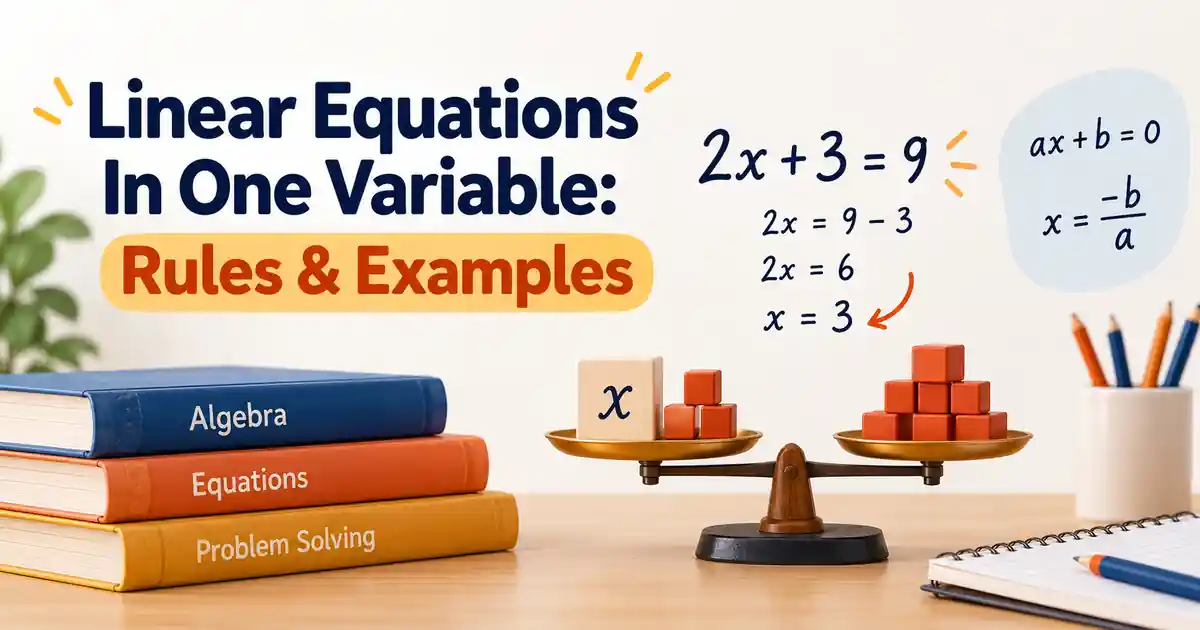
Solve .
Undo the addition by subtracting from both sides.
Final answer: . This is the first taste of solving: isolating the variable by doing the same thing to both sides.
Example 4
Solve .
Undo the subtraction first, then the multiplication.
Final answer: . Two-step equations reverse the order of operations: undo addition/subtraction before multiplication/division.
Example 5
What is of ?
Convert the percentage to a decimal and multiply.
Final answer: . "Percent" means "per hundred," so is , and "of" signals multiplication.
Example 6
Simplify the expression by combining like terms.
Group the terms that share the same variable, then the plain numbers.
Final answer: . You can only add terms that are "alike" — the -terms together, the constants together, never across the two.
Where Pre-Algebra Actually Leads
"How did letters ever get into arithmetic in the first place?"
The word algebra comes from the title of a book: al-Kitāb al-mukhtaṣar fī ḥisāb al-jabr waʾl-muqābala, written around 820 CE by the Persian scholar Muhammad ibn Musa al-Khwarizmi. The phrase al-jabr - "restoration," the act of moving a subtracted term to the other side of an equation - became the English word "algebra." What pre-algebra teaches as "do the same thing to both sides" is the twelve-hundred-year-old idea of al-jabr, and al-Khwarizmi worked it out entirely in words, before symbols even existed.
That history is a reminder of where the course is heading. Pre-algebra is not a collection of arithmetic drills; it is the on-ramp to a way of thinking where an unknown quantity gets a name and then gets found. Every later subject - the algebraic identities memorised in Algebra 1, the functions of Algebra 2, the calculus beyond - assumes the fluency built here. A student who leaves pre-algebra comfortable with signs, fractions, and the order of operations rarely struggles in algebra for arithmetic reasons; a student who does not, almost always does.
Common Mistakes
Mistake 1: Losing Track Of Negative Signs
Where it slips in: any expression that mixes addition and subtraction of signed numbers.
Don't do this: treat as "add the numbers, decide the sign at the end." That collapses three separate directional moves into one guess.
The correct way: handle one operation at a time, left to right, keeping each sign attached to its number. The student who rushes the sign work is usually strong at the arithmetic itself - the errors are almost never in the sizes of the numbers, only in the directions.
Mistake 2: Ignoring The Order Of Operations
Where it slips in: expressions with mixed operations, especially when a multiplication sits after an addition.
Don't do this: read strictly left to right to get .
The correct way: do multiplication and division before addition and subtraction, so . The memoriser who has "PEMDAS" as a chant but not as a habit tends to slip here the moment an exponent or a bracket is also present. Say what each letter stands for out loud once, and the convention sticks better than the acronym alone.
Mistake 3: Combining Terms That Are Not Alike
Where it slips in: simplifying an expression like .
Don't do this: merge the and the into . A variable term and a constant are not the same kind of quantity.
The correct way: only combine like terms - matching variables with matching variables, numbers with numbers. is already fully simplified; there is nothing to merge.
Conclusion
Pre-algebra is the bridge from arithmetic to algebra — number math to letter math.
It covers integers, fractions, decimals, ratios, percentages, exponents, the order of operations, variables, and simple equations.
Its purpose is fluency and readiness, not brand-new calculation.
The biggest leap is from evaluating expressions to solving equations, which is where algebra begins.
The costliest slips are sign errors, ignoring the order of operations, and combining unlike terms.
To build these foundations with a teacher, explore Bhanzu's algebra tutor sessions, structured math classes online, or one-to-one math tutoring. Want a live trainer to assess exactly where your child stands before algebra? Book a free demo class with a Bhanzu trainer.
Read More
Expression, term, factor, and coefficient — the vocabulary that names every part of an algebraic expression.
Algebraic formulas — a reference sheet for the expressions pre-algebra leads into.
Coefficient — the number multiplying a variable, and the first piece of algebra vocabulary.
Constants — fixed values, and how they differ from variables.
Types of polynomials — where expressions go once variables and exponents combine.
Was this article helpful?
Your feedback helps us write better content