Around 820 CE, a scholar in Baghdad's House of Wisdom wrote a book whose Arabic title contained the word al-jabr — meaning "restoration" or "the reunion of broken parts." Twelve centuries later, that word names the entire branch of mathematics this article is about. The scholar was Muḥammad ibn Mūsā al-Khwārizmī, and his book Kitāb al-Jabr wa-l-Muqābala described exactly the procedures students still call algebra today — moving terms across an equals sign, balancing both sides, solving for the unknown.
The basics of algebra are the small set of objects (variables, constants) and operations (addition, subtraction, multiplication, division, exponents, equals) you use to write down relationships involving unknown quantities and solve for them. Everything from a Grade 6 word problem to differential calculus is built on these five ideas.
What Is Algebra?
Algebra is the branch of mathematics that uses letters and symbols to represent numbers, quantities, and the relationships between them. Where arithmetic answers "what is ?", algebra answers "if , what is ?"
The five concepts that make up the basics of algebra:
Variables — letters that stand in for unknown numbers (, , ).
Constants — fixed numerical values (, , ).
Expressions — combinations of variables and constants joined by operations (, ).
Equations — statements that two expressions are equal ().
Inequalities — statements that one expression is greater or less than another ().
To "do algebra" is to apply legal moves — adding the same thing to both sides, factoring, distributing — that preserve the truth of the statement until the unknown stands alone.
The Building Blocks in Detail
Variables And Constants
A variable holds a value you don't yet know — or a value that can change. In , is the unknown; you do work to discover that . In the formula , the radius is a variable because it varies from circle to circle.
A constant does not change. In , the 3 and the 5 are constants (specifically, 3 is the coefficient of , and 5 is a free constant term).
Expressions vs Equations
An expression is a phrase: . No equals sign, so you can't "solve" it — only evaluate it (when given a value for ) or simplify it (combine like terms).
An equation is a sentence: . The equals sign asserts that the two sides are the same number. Solving the equation means finding the value (or values) of that make this assertion true.
Operations And The Order They Follow
Algebra inherits the four arithmetic operations — addition, subtraction, multiplication, division — and adds exponents and roots. The order of operations (PEMDAS in the US, BODMAS in the UK) tells you what to evaluate first: parentheses, exponents, multiplication and division (left to right), addition and subtraction (left to right).
For Grade 6–8 students at Bhanzu, the order-of-operations rule is reinforced in the first 12 minutes of every algebra session — because almost every error in the next 40 minutes traces back to a step taken out of order.
The Five Algebra Rules Every Student Needs
Rule | What it says | Example |
|---|---|---|
Commutative | Order doesn't matter for and | ; |
Associative | Grouping doesn't matter for and | |
Distributive | Multiplication distributes over and | |
Identity | Adding 0 or multiplying by 1 changes nothing | ; |
Inverse | Every has and (if ) | ; |
These five rules — together with "whatever you do to one side, do to the other" — are the entire grammar of school algebra.
Three Worked Examples — Quick, Standard, Stretch
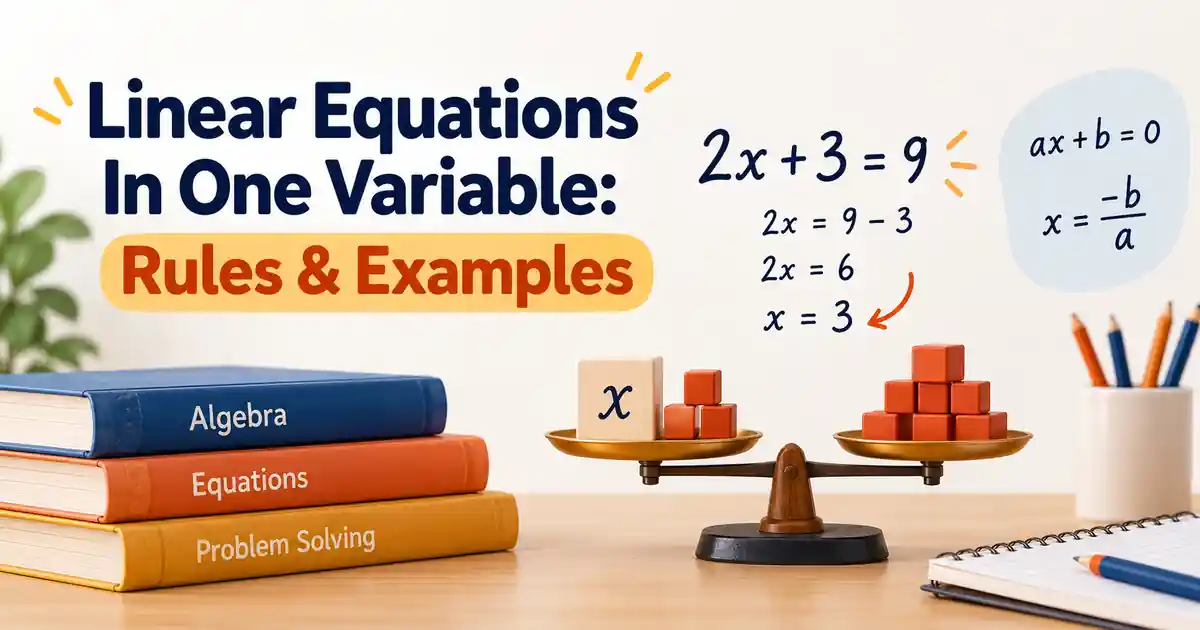
Quick. Solve .
Subtract 7 from both sides: .
Final answer: .
Standard (The Mistake Worth Making Once). Solve .
The wrong path. A student thinks "I'll move the 4 over first" and writes , then divides everything by : , which gives and . Plug back in: on the left and on the right. The number happens to be right, but the reasoning was broken — dividing both sides by assumed without checking, and the algebra was three steps longer than it had to be.
The rescue. Collect the variable terms on one side and the constants on the other. Subtract from both sides: . Add 4 to both sides: . Same answer, half the work, no hidden assumption.
Final answer: .
Stretch. Solve the literal equation for , where are constants and .
Subtract from both sides: .
Divide both sides by : .
Final answer: , valid for any . This is the general solution of a linear equation in one variable — every specific Grade 7 problem is a numerical instance of this formula.
Why Algebra Matters — The Real-World Pay-Off
Algebra is the language every quantitative field speaks. The substance of algebra — using a symbol to stand for an unknown so you can reason about it — is what makes science, engineering, and economics possible.
Physics. Newton's second law is an algebraic equation. Solving for any one of , , or given the other two is daily work for engineers.
Economics. Demand and supply curves intersect at a price solved by an algebraic system — exactly what Adam Smith described qualitatively a century before economists wrote it as equations.
Computer science. Every programming language uses variables — the algebraic idea of a named placeholder for a value. Recursion, complexity analysis, and cryptography are downstream of algebraic reasoning.
Medicine. Drug dosing scales an effective adult dose to a child's body weight by an algebraic ratio — the same proportion logic that drives Grade 6 worksheets.
"Whatever you do to one side, you do to the other." — the entire procedural heart of algebra, in eleven words.
Algebra also moved mathematics from describing numbers we already know to reasoning about quantities we haven't yet found. That shift — from arithmetic to algebra — is what made analytic geometry possible in the 1600s, and analytic geometry made calculus possible. Take away algebra and the entire chain collapses.
Slip-Ups That Cost Marks on Basics of Algebra
Mistake 1: Treating the equals sign as a "do this now" command.
Where it slips in: Younger students see as a prompt to compute, then in algebra carry that habit to , treating the left side as the "answer" and the right side as something to evaluate next.
Don't do this: Read as "compute , then equals that minus 2."
The correct way: The equals sign is a balance, not an arrow. and are two names for the same number. Solving means finding the that makes them name the same number: .
Mistake 2: Distribution errors with negative signs.
Where it slips in: A student expanding writes , missing the second sign flip.
Don't do this: .
The correct way: . The negative sign distributes across every term inside the parentheses. The "rusher" archetype gets caught by this almost every time a Bhanzu Grade 7 cohort works through their first multi-step equation.
Mistake 3: Combining unlike terms.
Where it slips in: A student simplifying combines all four terms without checking variable matches.
Don't do this: Report .
The correct way: Like terms share the same variable to the same power. and combine to ; stands alone; stands alone. Final form: .
The real-world version. When NASA's Mars Climate Orbiter was lost in 1999, one team's numbers were in pound-force-seconds and the other's were in newton-seconds. The teams "combined" unlike terms — quantities that looked similar (impulse) but were in different units. The result wasn't a bad answer; it was a destroyed spacecraft.
The People Behind Algebra
Muḥammad ibn Mūsā al-Khwārizmī (Persia/Baghdad, c. 780–850) wrote Kitāb al-Jabr wa-l-Muqābala around 820 CE. The word algebra comes from his title. His procedures for solving linear and quadratic equations are still recognisable in today's textbooks.
François Viète (France, 1540–1603) introduced the convention of using letters from the end of the alphabet for unknowns () and letters from the start for parameters (). Modern algebraic notation starts with him.
René Descartes (France, 1596–1650) standardised exponent notation ( instead of ) in La Géométrie (1637) and connected algebra to geometry through coordinates — the move that ultimately made calculus possible.
Why it matters: every notation in a modern algebra textbook is a hand-me-down from one of these three.
Conclusion
The basics of algebra are variables, constants, expressions, equations, and inequalities — five objects that combine to describe quantitative relationships.
The equals sign is a balance, not a command — every legal move applies to both sides at once.
Most beginner errors trace to negative-sign distribution or combining unlike terms — slow the algebra down at those two steps.
The word algebra comes from al-Khwārizmī's 820 CE treatise; modern notation is owed to Viète and Descartes.
Algebra is the entry point to every other quantitative field — physics, economics, computer science, medicine all run on it.
Sharpen Your Algebra — Three Practice Problems
Solve .
Simplify .
Solve the literal equation for .
If you get stuck on Problem 2, return to the negative-distribution mistake above — that's where most students lose the sign on the term.
Want a live Bhanzu trainer to walk your child through the foundations of algebra? Book a free demo class — online globally, or in person at our McKinney, TX center.
Was this article helpful?
Your feedback helps us write better content