
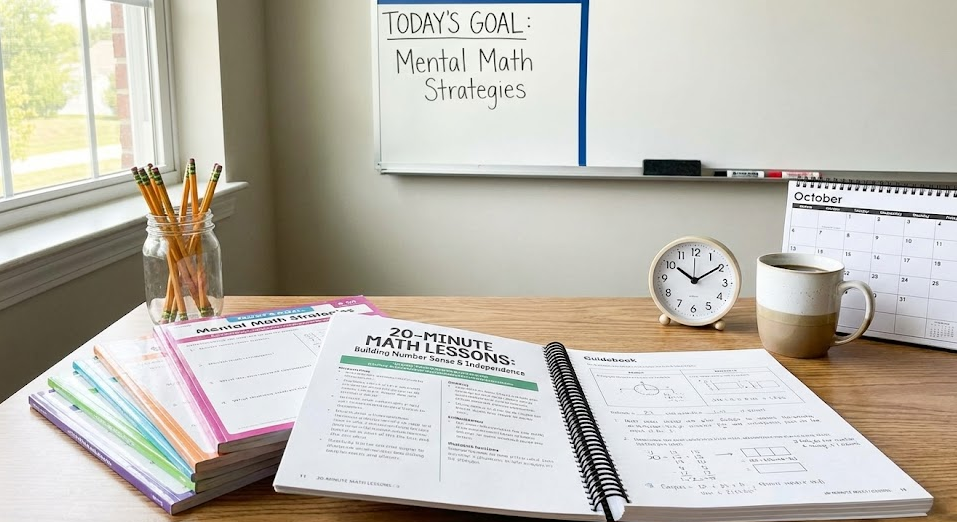
You want to help your child with math, but sitting down without a plan turns into frustration for both of you. 20 minutes pass. Your child still cannot explain the concept.
This guide gives you a practical roadmap to design 20-30 minute math lessons that strengthen number sense, reduce reliance on calculators, and encourage independent problem-solving. You need a clear structure and consistent short sessions.
Your busy schedule can handle this.
What a Short, Effective Math Lesson Must Accomplish
Every effective lesson plan for math focuses on one skill per session. Trying to cover multiple concepts in 30 minutes creates confusion instead of clarity.
Your lesson should include:
One clear learning goal (fluency, concept understanding, or problem-solving)
20-30 minutes total, including warm-up and reflection
Concrete representations (objects, drawings, stories) before abstract symbols
Quick checks that target understanding, not just correct answers
This clarity transforms your lesson plan for math from vague homework help into targeted skill-building.
7-Step Lesson Plan Template Parents Can Follow Tonight
You can follow these seven practical steps to build every lesson around clarity and measurable practice.
Step 1: Pick One Clear Objective
Choose a single learning goal and write it in parent-friendly language:
Kindergarten math lesson plans example: "Count objects up to 10 and match the number to the quantity"
Elementary math lesson plan example: "Add two 2-digit numbers with regrouping and explain where each digit goes"
Pre k math lesson plan example: "Recognize groups of 1, 2, and 3 without counting"
Write your goal at the top of a notebook page before you start.
Step 2: Quick Diagnostic (2-3 Minutes)
Spend 2-3 minutes on 3-4 quick problems to assess where your child stands.
Success indicators:
2 correct out of 3 signals readiness to proceed
0-1 correct suggests you need warm-up activities first
This diagnostic tells you whether to move forward or review prerequisites.
Step 3: Concrete Model and Explanation (5-7 Minutes)
Use manipulatives, drawings, or story contexts to demonstrate the concept before introducing numbers and symbols.
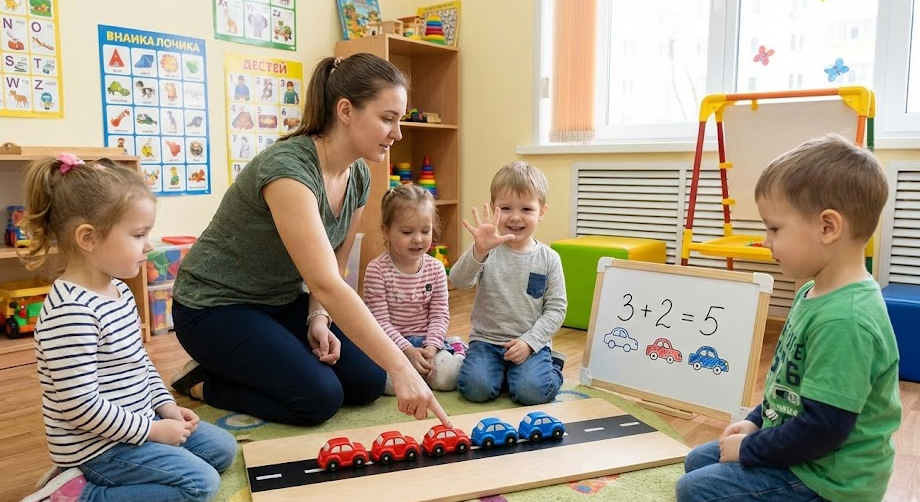
Math lesson plan for preschool: Use toy cars to show "3 cars and 2 more cars make 5 cars"
Elementary: Show regrouping with place-value cards or coins. Trade 10 ones for 1 ten while your child watches.
Transfer indicator: Ask your child to teach back one step in their own words.
Concrete representations make abstract math visible.
Step 4: Guided Practice (8-10 Minutes)
Work through 4-6 scaffolded problems together. Start with heavy support and gradually reduce hints.
How to scaffold:
Problem 1: You demonstrate while explaining every step
Problems 2-3: You ask guiding questions; child does the work
Problems 4-6: Child works independently; you watch and only prompt if stuck
Success indicator: Complete 4 problems with 80% accuracy, or reduce parent prompting by half.
Step 5: Independent Check (3-4 Minutes)
Give a short solo set of 3 problems with a time or accuracy target.
Goal phrasing options:
"Achieve 2 out of 3 correct independently"
"Complete within 4 minutes"
Example for kindergarten: "Put the correct number of stickers next to each numeral (3, 5, 7)"
Example for elementary: "Solve these three word problems without help"
This independent check shows whether your child internalized the concept.
Step 6: Reflection and Language (2-3 Minutes)
Ask your child to explain their thinking in 1-2 sentences.
Example prompts:
"Tell me one reason you moved the tens"
"What did you do first when you saw this problem?"
"Which step felt hardest?"
This reflection builds mathematical communication skills and reveals gaps you might have missed.
Step 7: Plan the Next Mini-Step (1 Minute)
Decide your follow-up based on today's results:
Repeat similar task: If accuracy was below 70%
Increase difficulty: If accuracy was above 85% with confidence
Practice transfer: If child mastered the skill; apply it to real-world examples
You can write this next step in your notebook so you do not waste time planning tomorrow.
Turn This Template Into Your Family's Math Routine
You now have a repeatable structure that works across ages and topics. Print this template. Keep it next to your homework space.
Tonight, pick one skill your child needs to practice. Follow the seven steps for 25 minutes. Within three sessions, you will see clearer explanations, fewer calculation errors, and growing confidence.
Want expert guidance on building math skills systematically? Explore a demo class where structured lesson planning meets personalized instruction tailored to your child's learning pace.
Was this article helpful?
Your feedback helps us write better content