Most parents searching for nursery maths activities have already pictured the goal: a confident three-year-old reciting numbers up to twenty, naming shapes on flashcards, maybe even working out that one plus one is two.
That's not what nursery maths is for.
Nursery maths - the part that actually matters at ages three and four - is about whether your child knows that the word "three" stands for a quantity, not just a sound they've memorised. It's about whether they can sort socks by colour, spot a pattern in their cereal bowl, and tell you which puddle is bigger. The activities below are organised around what your child is actually building, not what looks impressive at a dinner party. Pick one skill area, try a few activities, and let the rest sit.
What Nursery-Age Math Actually Looks Like (Ages 3–4)
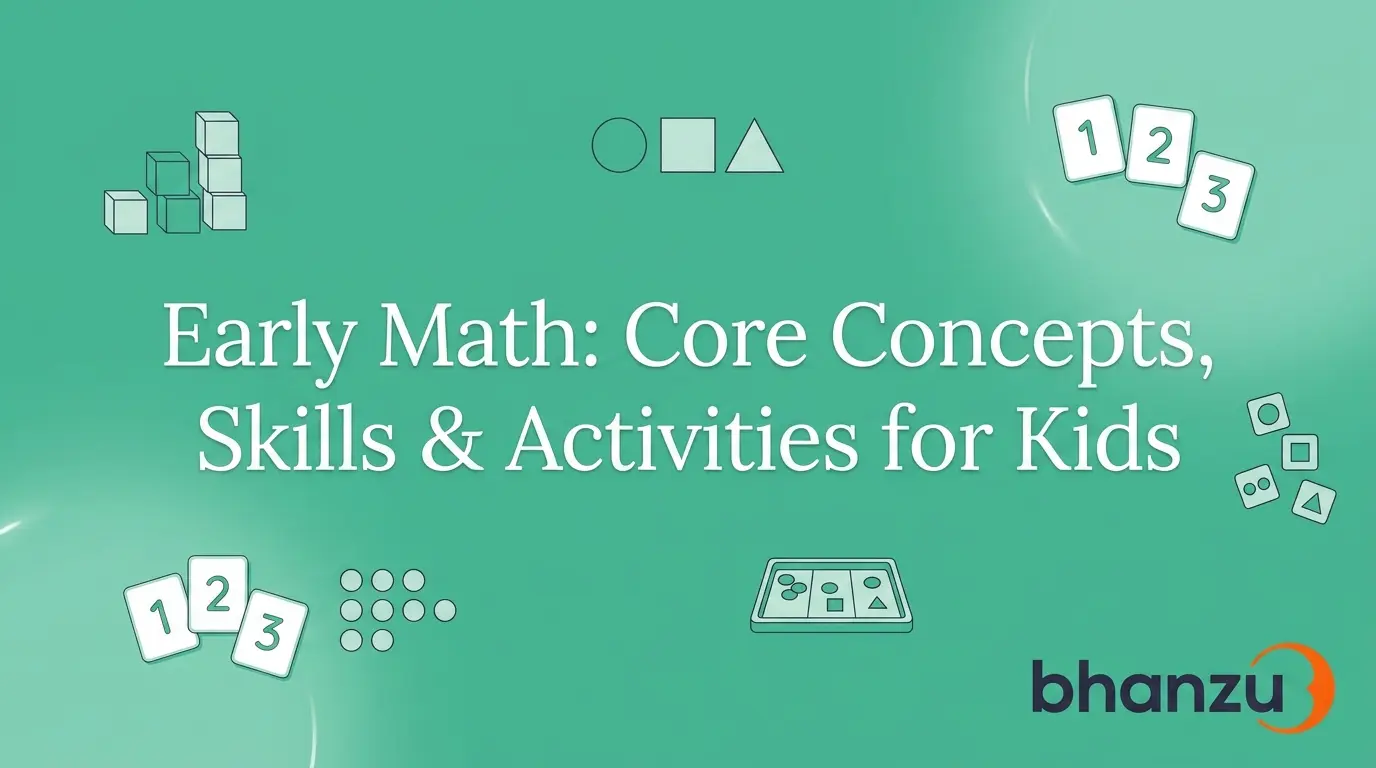
A 3–4 year old is exploring four things, none of which they're meant to master: number sense, comparison, shapes and space, and patterns. Each one is a foundation, not a finished skill.
Number sense is knowing what numbers mean — not how to write them. Comparison is the language and logic of more, less, bigger, smaller. Shapes and space cover both flat shapes (circles, squares) and where things sit in relation to each other (on, under, between). Patterns are spotting and predicting what comes next.
A note on curriculum frameworks: Both the Early Years Foundation Stage (EYFS) framework in the UK and India's NCERT pre-primary guidelines anchor early maths to these same four areas. Wherever you live, your child is being introduced to roughly the same set of building blocks.
The Four Skill Areas — and Activities for Each
1. Number Sense (Counting That Actually Means Something)
I've watched a four-year-old recite "1, 2, 3, 4, 5" while pointing at the same teddy three times. The numbers came out perfectly. The counting did not.
This is the most useful distinction in nursery maths, and almost no one explains it to parents. Your child can be excellent at the number song and still not understand counting. Reciting "1, 2, 3, 4, 5" is rote counting — a memorised sequence, like the alphabet. Counting is what happens when each number word matches one object. That's called one-to-one correspondence, and it's the actual skill.
There's a second skill that sits alongside it: subitising. That's the ability to look at three dots on a dice and just know it's three, without counting. Most three-year-olds can subitise up to two. By four, many can do up to three. (I'll be honest - I had to look up the word subitising the first time I came across it. Most parent guides skip the term entirely. But it's worth knowing, because it's how your brain reads a domino without counting the pips.)
Readiness signs:
Your child reliably touches each object as they count it
They stop and say "wait" if you skip an object
When you ask "how many?" they answer with the last number they said, not the first
Activities:
Count five things. Pick one type of object. Five spoons, five socks, five stairs. Have your child touch each one as they count. Don't go beyond five at first.
Dice subitising. Roll a single dice. Ask "how many?" without letting them count. They'll start to recognise small numbers as patterns, not totals.
Counting songs with action. Five Little Ducks. One Two Buckle My Shoe. The body movement helps the number land as a quantity, not just a sound.
The "is it still five?" check. Count five buttons. Spread them apart. Ask again. If your child counts again to confirm, they're still building the idea that quantity stays the same when arrangement changes. (This is called conservation of number. It's the bridge to addition later.)
What I'd watch out for: it's tempting to push your child to count to twenty, then thirty, then fifty, because the number song is a quick win and feels like progress. It's not progress. It's a parlour trick. A child who can count five objects accurately is doing real math. A child who recites to fifty without knowing what twelve means is doing none.
2. Comparing and Sorting (Bigger, Smaller, More, Fewer)
Comparison is the doorway to almost all later math. If your child can't tell you which pile has more, addition won't make sense to them when it arrives.
The thing most parents miss is that comparison is built mostly through language, not numbers. A 3–4 year old learns comparison by hearing the words used: bigger, smaller, taller, heavier, more, fewer, same, different. Use them all day. Point them out. "Your bowl has more berries than mine." "This shoe is heavier." "Pass me the bigger spoon." This sounds too small to count as math. It is the math.
Sorting works the same way. Your child takes a pile of mixed-up things and groups them by one attribute - colour, size, shape. That single act builds the cognitive structure they'll later use for fractions, sets, and probability.
Readiness signs:
They use comparison words on their own ("this one is bigger")
They can sort a small group of objects by one attribute
They notice differences without being asked
Activities:
Laundry sorting. Pair socks. Group clothes by who they belong to. Hand them an item: "where does this go?"
Heavier or lighter? Hold up two grocery items. Ask which one weighs more. Let them feel both before answering.
Sorting bowls. Buttons, dry pasta, leaves from a walk — anything in a mixed pile. Set out three bowls. Sort by one rule. Then change the rule.
Big-small hunts. On walks, point at things. "Find me something bigger than your hand." "Smaller than your shoe." "Heavier than this pebble."
3. Shapes and Space (How Things Fit and Where Things Go)
Shapes work in two directions. One is recognising 2D shapes — circle, square, triangle, rectangle. The other, less talked about, is spatial language: on, under, behind, between, next to, in front of.
Spatial language is the underrated half. It's how your child learns to follow directions, read a page from left to right, and understand geometry years later. Children with stronger spatial vocabulary tend to do better in math overall, not just geometry, because position and arrangement underlie a lot of how numbers work.
Readiness signs:
They name circles and squares without prompting
They use spatial words correctly ("the cat is under the table")
They fit shapes into puzzles, even with trial and error
Activities:
Shape hunt. Pick a shape. Ask your child to find three of them in the room. Then in the kitchen. Then on the next walk.
Block-building narration. As they build, narrate: "you put the red one on top of the blue one." "Now the yellow one is behind the red one." Don't make them repeat the words. Just let the language wash over them.
Where is teddy? Hide a soft toy. Describe its location only with spatial words. "Teddy is between the sofa and the wall."
Drawing shapes in different mediums. Sand, salt on a tray, finger paint, chalk on the pavement. The hand muscle memory matters as much as the visual recognition.
4. Patterns (Spotting What Comes Next)
Patterns are the entry point to algebra. Long before x and y arrive, a child learning to predict "red, blue, red, blue, ___" is doing the same kind of thinking. They're noticing a rule, then applying it.
Most three-year-olds can copy a pattern. By four, many can extend one. By five, some can create their own. The progression isn't a race.
Readiness signs:
They can complete a simple ABAB pattern when shown one
They spot patterns in the world ("look, stripes!")
They start to make their own
Activities:
Bead patterns. String beads on a pipe cleaner — alternate two colours. Then three. Let them invent their own.
Body patterns. Clap-stomp-clap-stomp. Touch nose, touch toes, touch nose, touch toes. Patterns the body remembers.
Pattern walks. Stripes on a zebra crossing. Paving slabs in twos and threes. The rhythm of streetlights. Pattern-spotting becomes a habit.
The deliberate mistake. Set out red-blue-red-blue-green. See if your child catches it. If they do, the pattern is real to them, not just imitated.
How to Slip Math Into Your Day Without Making It a Lesson
The most useful nursery maths happens in the time you're already doing other things. Cooking, walking, bath, getting dressed. You don't need a craft drawer. You need a habit.
Count stairs going up. Name shapes in the cereal box. Compare tower heights at bath time. Sort laundry. Ask "how many forks?" when you're setting the table. Notice the pattern of paving slabs on the way to the park.
The bigger habit, behind all the small ones, is math language. Pointing out math vocabulary in everyday speech does more for your child than most worksheets. "Do you want more milk?" "Pass me the bigger spoon." "We have two socks left." A child who hears math words used naturally builds quantity sense without ever sitting down to a lesson.
Five minutes here. Three minutes there. That's the dose. Don't try to make it a lesson — once your child senses you're testing them, the play disappears.
What to Do When Your Child Isn't Engaging
This is the part nobody talks about. So let's talk about it.
They lose interest after two minutes. That's not a problem. That's a three-year-old. A focused session at this age is five to ten minutes, and even that's a long time. Stop before they're bored, not when they're bored. The next session always goes better when the last one ended on a high note.
They get the answer wrong and shut down. Don't correct directly. Reset the question with fewer objects. If they couldn't count five, try with three. The skill is the same. The load is lighter. Once they succeed, build back up.
They refuse the activity entirely. Drop it. Try the same skill in a different format — counting on a walk instead of with cards, sorting laundry instead of buttons. The skill is what matters, not the activity. There are usually three or four ways to practise the same thing.
They seem behind their friends. Comparison rarely helps and often hurts. Children learn to count meaningfully somewhere between two and five years old. That's a three-year window of "normal." A four-year-old who isn't counting yet is not behind a three-year-old who is — they're on a different schedule.
They want to do the same activity over and over. Let them. Repetition is exactly how this age learns. The fifth time they sort the buttons, they're noticing things they missed the first four. (My one rule: when you can tell they're getting bored, even if they're still asking for it, that's the moment to gently move on.)
Signs Your 3–4 Year Old Is Building Math Confidence
Confidence at this age looks like willingness to try, not getting answers right.
Watch for these in everyday play:
Counting toys without being asked
Asking "how many?" themselves
Using comparison words on their own
Spotting patterns out loud, unprompted
Trying puzzle pieces by trial and error rather than giving up
Playing pretend shop, pretend kitchen, pretend restaurant
If you see two or three of these on most days, your child is on solid ground. You don't need a curriculum. You need to keep doing what you're already doing.
When to Get Outside Help
Most 3–4 year olds don't need structured math support. They need consistent, low-pressure play and exposure at home. That's it.
A few things, though, are worth paying attention to. Consider speaking to your child's preschool teacher or a paediatrician if:
By age four, your child still cannot reliably count three objects with one-to-one correspondence after months of casual practice
Number words feel like meaningless sounds to them, with no quantity attached, even after lots of exposure
They show real distress around any counting or sorting activity — not just disinterest, but upset
They cannot yet sort a small group of objects by one obvious attribute, like colour
They've shown persistent avoidance of math-flavoured play across many different formats over several months
Most concerns at this age resolve themselves with time. Some don't. Either way, a teacher's perspective is usually the best first step — not a tutoring program, not an app. Just an adult who watches your child in a group setting.
Where to Go Next
Pick one skill area this week. Just one. Try two or three of the activities under that skill. Watch what your child does — what catches them, what frustrates them, what they ask for again.
Come back next week. Pick another.
If you'd like a structured next step when your child reaches kindergarten, Bhanzu's free demo class is the simplest way to see where they are and what comes next.
Was this article helpful?
Your feedback helps us write better content