

Your child stares at a challenging word problem for 30 seconds, then announces, "I'm just not good at math. I can't do this."
They close the workbook before attempting a solution. The fixed mindset has taken hold, and it shows up most clearly in math, where problems have definite right and wrong answers that feel like judgments on ability.
Understanding fixed vs growth mindset helps you recognize what's holding your child back and gives you concrete language to shift their thinking.
This guide explains the difference, shows how mindset specifically impacts math learning, and provides immediate strategies to build persistence through tough problems.
Fixed vs Growth Mindset: The Core Difference
There are two fundamental beliefs about ability that shape how children approach challenges.
Fixed Mindset | Growth Mindset |
|---|---|
Intelligence and math ability are traits you're born with | Abilities develop through effort, practice, and learning from mistakes |
Struggles mean you lack talent | Struggles mean you're learning and building new neural pathways |
Mistakes reveal inadequacy | Mistakes provide information for improvement |
Effort is pointless if you're "not a math person" | Effort is the path to mastery |
Avoids challenges to protect self-image | Seeks challenges to develop skills |
Let's now check out how each mindset affects your child's approach to solving tough math problems
How a Fixed Mindset Blocks Math Progress
Fixed mindset creates specific obstacles that prevent children from developing mathematical competence.
Pattern 1: Immediate surrender Your child encounters a problem type they haven't seen before and immediately asks for help without attempting any solution strategy. They believe not knowing instantly means they can't figure it out.
Pattern 2: Strategy abandonment After one unsuccessful approach, your child declares the problem impossible rather than trying a different method. They interpret the failed attempt as confirmation they lack ability.
Pattern 3: Praise dependence Your child only attempts problems they're confident will be correct, seeking constant reassurance. They need external validation because they don't trust their own problem-solving capacity.
Pattern 4: Comparison fixation Your child constantly compares their math speed or grades to classmates, using others' performance as evidence of their own limitations rather than seeing varied learning timelines.
These patterns compound over time. A child who avoids challenging problems doesn't build the skills to tackle them later, creating a self-fulfilling prophecy about their math limitations.
How Growth Mindset Builds Math Persistence
Growth mindset for math transforms how children interpret difficulty and approach problem-solving.
What changes:
Mistakes become information rather than judgments
Getting stuck becomes expected rather than shameful
Multiple attempts become normal rather than evidence of inability
Not knowing yet becomes different from never knowing
Practical example: A child with growth mindset encounters a fraction division problem they can't solve immediately. Instead of shutting down, they think: "I haven't learned this method yet. Let me try drawing a picture or looking at a similar problem we did yesterday."
So, how can you help your child shift from a fixed to a growth mindset? You can try the following language shifts.
5 Language Shifts That Build Growth Mindset for Math
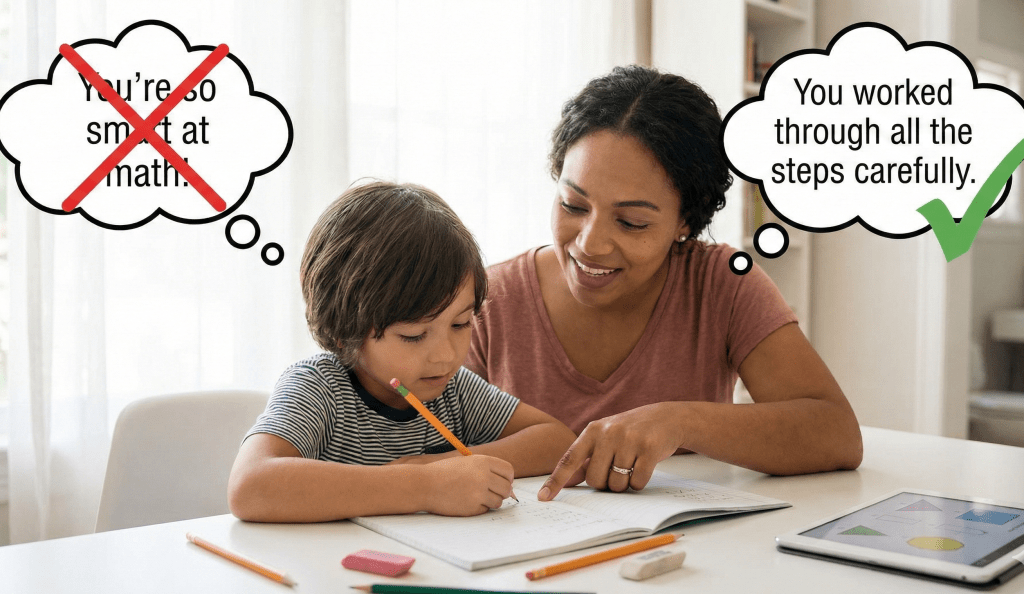
Change how you respond to math struggles using these specific phrase replacements.
Instead of "You're so smart at math!" try: "You worked through all the steps carefully." Why: Praise process and strategy rather than innate ability.
Instead of: "This is easy, you can do it," try: "This is challenging. Let's figure it out together." Why: Validates difficulty while emphasizing problem-solving as a learnable skill.
Instead of: "That's wrong. Try again," try: "Your first two steps are correct. What happens next if we regroup here?" Why: Acknowledges progress and directs attention to the specific learning point.
Instead of: "Some people are just better at math," try: "Math gets easier with practice, just like learning to ride a bike took practice." Why: Reinforces that struggle precedes mastery in all skills.
Instead of: "Why can't you get this?" Try: "What strategy could you try first?" Why: Focuses on action rather than judgment.
These language shifts provide concrete tools to build persistence, resilience, and genuine mathematical confidence.
Shifting Your Child's Math Mindset Starting Tonight
Understanding fixed vs growth mindset gives you the framework to recognize what's blocking your child's math progress.
Start tonight by replacing one fixed mindset phrase with a growth mindset alternative during homework.
Within two weeks, you'll notice your child attempting harder problems longer before giving up and showing less frustration when answers aren't immediately obvious.
For structured math instruction that builds growth mindset for math through concept-first
teaching and celebrates productive struggle, consider booking a demo class where instructors model these approaches.
Was this article helpful?
Your feedback helps us write better content