If you’ve ever watched your child blaze through a math game… and then freeze on a word problem at school, that contrast probably felt confusing.
Most educational math games look impressive on the surface. Bright colors. Cheerful sounds. Lots of “Correct!” messages. But many of them don’t actually help children think.
Problem-solving is what shows up when the game ends. When the numbers change. When there is no hint button.
The good news is that the right educational math games for kids can help, if they’re used the right way. Let’s talk about what actually works at home.
What to look for before calling a game “educational”
Before your child plays, ask yourself one simple question: Does this game allow my child to be confused for a moment? Strong educational math games for kids usually:
Do not rush with timers
Do not punish wrong answers immediately
Let children undo, rethink, and retry
Encourage explanation, not just clicking
Speed-based games feel productive. Thinking-based games actually are.
Educational math games that build real problem-solving
This is where most parents accidentally ruin a good thing:
1. Puzzle games that make kids stop and stare
These are the games where your child leans back, frowns a little, and says, “Hmm.”
Examples:
Sudoku or mini logic grids
Pattern puzzles
Maze-style number challenges
What this teaches: Children learn to plan instead of guess.
What to say as a parent. Instead of “Try again,” say:
“Tell me what you’re thinking right now.”
That sentence alone changes how the brain engages.
2. Number games that don’t tell kids what operation to use
Some of the best educational math games for kids do not say “add” or “multiply.” They say, “Make this number.”
Examples:
Use a set of given numbers and any basic operations to reach a target number. For example, use 4, 1, 6, and 8 to make 24
Number cards with flexible operations
Mental math challenges with constraints
What this teaches:
Numbers stop being rules and start becoming tools.
Try this at home:
Say:
“You can solve this, but today subtraction is not allowed.”
You will see deeper thinking instantly.
3. Hands-on games that work especially well for younger kids
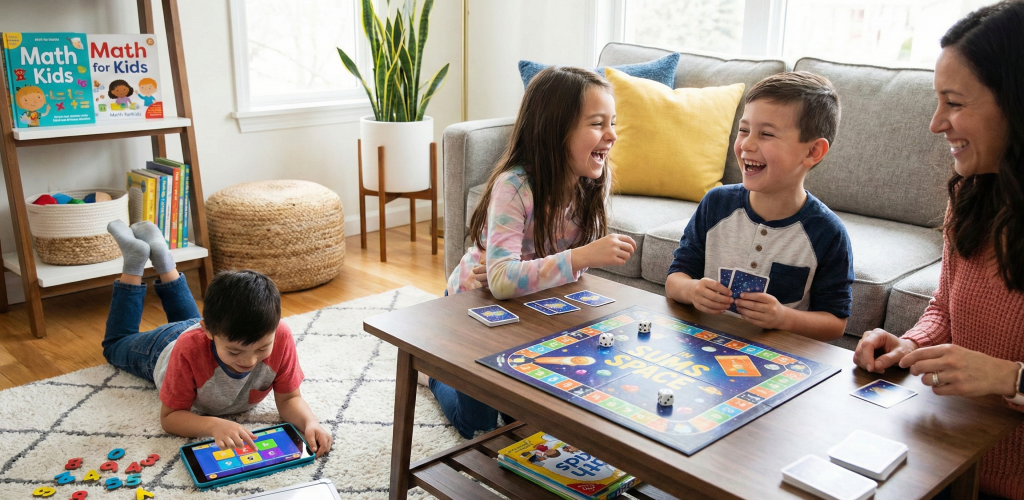
For educational math games for kindergarteners, hands-on beats screen-based almost every time.
Examples:
Tangrams
Pattern blocks
Shape matching games
Counting games with objects
What this teaches: Children understand before they calculate.
Parent moment to watch for: When your child moves pieces around silently before speaking, learning is happening.
4. Educational math games online that encourage explanation
Screens are not the enemy. Mindless speed is. Good educational math games online pause after mistakes and show visual reasoning.
How to use them better. After one level, stop the game and ask:
“Explain how you knew what to do.”
If they can explain it, the game is working.
How to actually use math games at home (without fights)
If math games at home keep ending in resistance or arguments, it usually comes down to a few small habits that are easy to fix:
Stop measuring time. Measure thinking.
Instead of:
“Play for 20 minutes”
Try:
Solve two puzzles slowly
Explain one solution
Find another way to solve the same problem
This removes pressure and builds confidence.
Let your child struggle a little
This part is hard for parents.
When your child is stuck, resist fixing it.
Ask:
“What have you tried so far?”
“Why do you think it didn’t work?”
“What could you try next?”
Problem-solving grows in that uncomfortable pause.
Talk while playing
Quiet clicking often means guessing.
Encourage:
Talking out loud
Drawing ideas
Using fingers or objects
This is crucial for educational math games for kindergarteners, where thinking is physical before it is verbal.
A realistic weekly math game rhythm
Day | What to play | What you’re building |
|---|---|---|
Monday | Logic puzzle | Planning |
Wednesday | Number puzzle | Flexibility |
Friday | Visual game | Concept clarity |
Sunday | Explain one game | Confidence |
Fifteen focused minutes beats an hour of rushed play.
How Real Math Skills Grow at Home
The best educational math games feel quiet, slow, and thoughtful. Used well, they help children learn how to think when they are unsure, a skill that lasts far beyond levels and scores.
That same thinking-first approach is at the core of Bhanzu, where children are guided to reason, pause, and truly understand math, not rush through it.
Sit nearby. Ask better questions. Let thinking lead.
That is where real learning happens. If you want your child to experience this approach in a structured way, book a demo now and see how thoughtful math learning is taught in action.
Was this article helpful?
Your feedback helps us write better content