
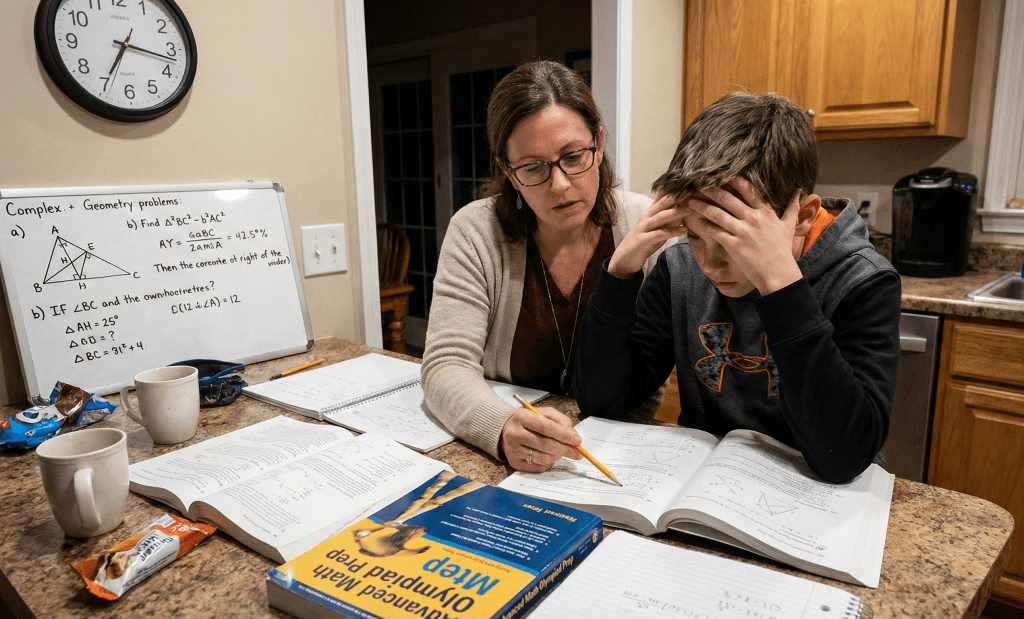
When it comes to math Olympiad courses, you'll see that some programs push endless worksheets. However, the most effective courses emphasize deep problem-solving, contest strategy, and steady confidence-building. You want serious preparation, but the options feel overwhelming.
This guide gives you a targeted decision checklist, course features, and vetting questions to trial a course this week. When you're ready to invest in your child's mathematical growth, this framework helps you choose with confidence.
What Serious Olympiad Preparation Looks Like
Before evaluating any math Olympiad course, understand what outcomes serious preparation delivers.
Conceptual Fluency: Your child solves unfamiliar contest problems by recognizing underlying patterns, not memorizing solution templates.
Problem Selection Strategy: Your child quickly assesses which problems to attempt first and how to allocate time across a contest.
Performance Under Pressure: Your child maintains accuracy and clear thinking during timed conditions.
The distinction matters: high-volume drilling teaches pattern matching. Thinking-focused practice teaches adaptable problem-solving.
Measurable Success Indicators
Accuracy-based: Correctly solves 6 of 8 mock problems at appropriate difficulty
Time-based: Completes targeted problem set in 40 minutes with maintained accuracy
Confidence: Volunteers to attempt harder problems unprompted
Use these benchmarks when evaluating whether a math Olympiad course online delivers real results.
The Course Landscape: Common Program Types
Understanding program types helps you identify what matches your child's needs.
Program Type | What It Offers | Best For | Typical Limitation |
|---|---|---|---|
Drill-Heavy Programs | Large problem volumes with answer keys | Building speed on familiar patterns | Limited strategy development |
Concept-First Courses | Deep exploration of mathematical ideas | Students needing stronger foundations | May need supplemental timed practice |
Hybrid Programs | Balanced concept teaching plus timed mocks | Comprehensive preparation | Higher time commitment |
Self-Paced Libraries | Flexible learning on student's schedule | Independent learners | Requires strong self-motivation |
Serious preparation programs combine conceptual depth with strategic training and regular timed practice.
Six Features That Predict Contest Success
When evaluating any math Olympiad online course, assess quality using these differentiators.
Feature | What to Look For | Question to Ask | Success Indicator |
|---|---|---|---|
Curriculum Design | Concept-first sequences scaffolding from ideas to contest variants | "Show me a 4-week progression for geometry problems" | Student explains why a technique works |
Instructor Expertise | Teachers with contest experience providing targeted feedback | "What's the instructor's competition background?" | Student self-corrects after one hint |
Timed Mocks | Frequent timed tests with solution debriefs | "How often are full practice tests given?" | Time-per-problem reduces 20% in 6 weeks |
Problem Calibration | Sets that challenge without demoralizing | "How do you adjust difficulty as students improve?" | Student maintains 60%+ accuracy on stretch problems |
Strategy Training | Explicit teaching of heuristics and contest tactics | "Do you teach contest-taking strategies?" | Student applies heuristic to homework unprompted |
Progress Tracking | Clear metrics with regular parent communication | "How will I know my child is improving?" | Week-by-week notes with measurable goals |
Your Quick Vetting Checklist
Use these questions during demos to assess program quality.
Curriculum and Assessment
Can you provide sample timed tests and a scored student paper?
Can you show a week-by-week skill progression for my child's level?
Instruction and Support
How often do students receive one-on-one feedback?
What's the instructor-to-student ratio during live sessions?
Progress and Communication
How do you measure and report improvement?
How many contests do your students typically enter annually?
Practical Logistics
What's your cost structure, refund policy, and trial period?
Can my child trial a class before committing?
Programs confident in their quality answer these questions transparently with concrete examples.
Online Course Considerations
When choosing a math Olympiad course online, weigh these format-specific factors.
What Online Programs Offer: Access to top instructors regardless of location, flexible scheduling around school commitments, and typically lower costs than in-person programs.
What They Require: Your child needs ability to focus during screen-based instruction, reliable technology, and (for younger students) occasional parent check-ins to maintain engagement.
Platforms like Bhanzu combine live online instruction with interactive problem-solving, structured feedback, and progress tracking in an accessible format.
Your Action Plan This Week
You're taking the right step by evaluating options carefully.
Tonight, run a simple test. Give your child one contest-level problem. Time them for 20 minutes. Observe: Do they attempt multiple approaches? Do they persist when stuck? This shows their current baseline.
This week, trial two programs. Use the vetting checklist to evaluate two courses. Attend demo classes. Compare how each addresses the six critical features.
Then, make your decision. Choose the program where your child engages naturally, where instructors provide concrete metrics, and where the balance of concept work, strategy, and timed practice matches your child's needs.
Selecting a math Olympiad course with the right mix of strategic thinking, feedback, and realistic practice sets your child up for measurable gains.
You may explore a demo class designed to build deep problem-solving skills in an engaging environment with Bhanzu!
Was this article helpful?
Your feedback helps us write better content