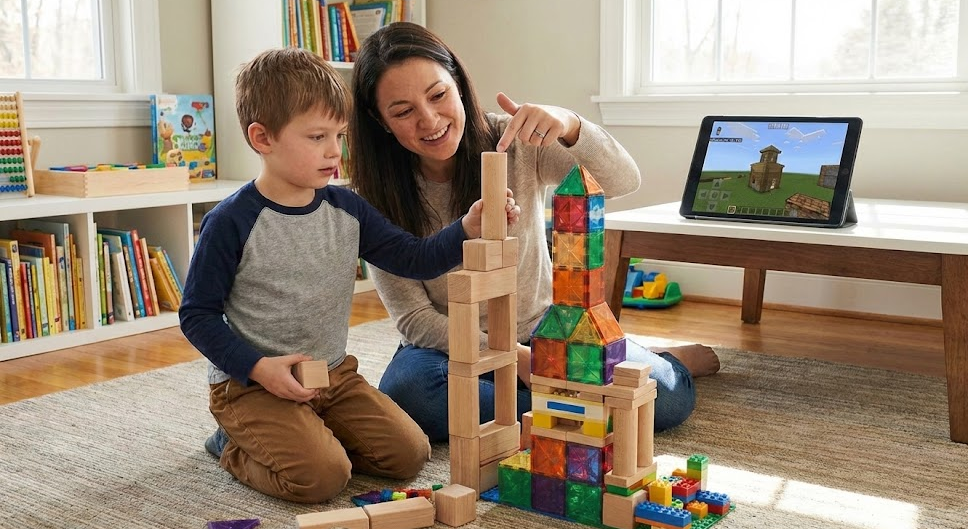
When your child lines up blocks and experiments with balance, they're doing more than playing. Those towers and structures represent complex mathematical thinking in action.
This guide provides specific block-based activities to strengthen spatial reasoning, counting, and early algebraic thinking with measurable goals and quick success checks. Your child will build spatial vocabulary, improve mental rotation and estimation, and transfer these skills directly to homework involving fractions, geometry, and measurement.
Let's explore why blocks work and which skills they target.
Why Block Games Rapidly Build Spatial Reasoning and Math Skills
Block play forces children to predict outcomes like will the tower stand? Will it balance? This constant need for prediction helps them practice spatial visualization and logic. Each time your child decides where to place the next block, they're calculating weight distribution and structural integrity.
Repeated building and layering develops estimation, pattern recognition, and early algebraic strategies. Children naturally discover symmetry and begin understanding equations as balance.
The hands-on nature of blocks makes abstract concepts tangible. When children physically manipulate blocks, they internalize spatial relationships that later translate to mental math and visual problem-solving.
Core Block Activities
Activity 1 — "Mirror Towers"
Materials: 20 uniform blocks
Time: 10-15 minutes
Steps:
Build a simple asymmetric tower using 5-7 blocks
Ask your child to build an exact mirror image beside yours
Increase complexity after each successful round
Skills targeted: Mental rotation, symmetry, spatial language (left/right, flipped)
Success indicators: Your child reproduces mirror tower with ≤2 mistakes; completes within 4 minutes; volunteers to attempt next-level mirror
Activity 2 — "Balance Equation"
Materials: Blocks, flat ruler as balance
Time: 10 minutes
Steps:
Create a see-saw using ruler balanced on one block
Assign weights (1 block = 1 unit)
Challenge your child to balance different combinations on each side
Skills targeted: Early algebraic thinking, equivalence, proportional reasoning
Success indicators: Your child finds 3 different combinations that balance within 2 attempts each; later applies concept to "both sides equal" homework questions
Activity 3 — "Guess & Measure"
Materials: Blocks, measuring tape
Time: 8-12 minutes
Steps:
Your child builds a wall and estimates its height/width
You and your child measure together to check accuracy
Track estimation improvement over sessions
Skills targeted: Estimation, units, measurement vocabulary
Success indicators: Reduces estimation error from ±30% to ±15% within 3 sessions; measures independently
Activity 4 — "Blueprint Challenge"
Materials: Graph paper, blocks, pencil
Time: 15-20 minutes
Steps:
You sketch a simple top-down blueprint (3-5 squares wide)
Your child recreates a structure using blocks
Your child creates their own blueprint for you to build
Skills targeted: Spatial planning, 2D to 3D translation, communication
Success indicators: Your child creates a blueprint that you reproduces with ≤2 clarifying questions; your child explains the plan in 1-2 sentences
Quick Implementation Notes for Busy Schedules
During toy cleanup, challenge your child to stack blocks into specified shapes in 3 minutes. While packing a lunchbox, have them arrange containers to use space efficiently.
When schedules are packed, keep sessions short and purposeful. 10 minutes is enough to practice one targeted skill.
Variations & Scaling: From Preschool to Upper Elementary
Preschool: Focus on symmetric towers and simple balance. Target: complete basic mirror within 2 attempts.
Early elementary: Introduce measurement units and see-saw balancing for equivalence. Target: 80% accuracy on balance combinations.
Upper elementary: Increase blueprint complexity, add timed challenges, and introduce fractional block units (half-blocks) for fraction concepts. Target: recreate blueprints with ≥90% fidelity.
Common Mistakes & Quick Fixes
If your child gets frustrated, reduce complexity and praise incremental attempts. When they copy without thinking, pause and ask prediction questions like "Will it topple?" This promotes metacognition.
If math transfer stalls, explicitly connect play language to homework: "That balance idea is like solving for x."
Quick Advice: Keep a "Guess Jar" labeled with weekly block-height guesses; reveal on Sunday. This improves estimation and creates low-pressure tracking.
How Block Play Shows Up in Real Math
Picture your child confidently planning and explaining their structures, using spatial language during homework, and approaching geometry with less anxiety. These aren't distant goals, they're achievable through consistent, targeted block sessions.
Just 10-15 minute sessions yield measurable gains in spatial reasoning and math transfer within weeks. You don't need extra materials, your child's play already contains math-ready moments.
Ready to support your child's mathematical journey further? Explore a demo class for guided, concept-first math support that builds on these foundational skills.
Was this article helpful?
Your feedback helps us write better content