

Learners in blended educational settings demonstrate 88% cognitive involvement and 78.6% emotional engagement. These numbers tell you something important. The blended instructional approach promotes better mental investment.
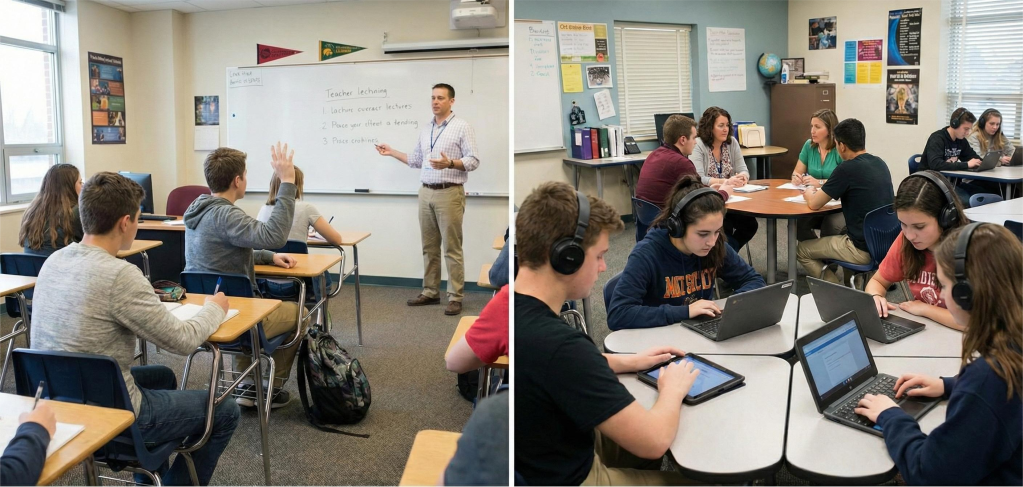
Blended learning combines guided instruction with targeted online practice. In purely in-person learning, everyone moves at the same pace, and in fully online programs, students can feel isolated. However, a hybrid model gives your child face-to-face support when they need guidance and self-paced digital practice when they are ready to move ahead.
The result is more immediate feedback, personalized pacing, and learning that adapts to how your child thinks.
Here is what that looks like in practice.
The 3 Core Benefits of Blended Learning That Make a Difference
The benefits of blended learning show up in how your child interacts with material, how much they remember later, and whether the instruction fits their actual learning needs.
1. Higher Engagement: Students Stay Focused Longer
Traditional classrooms often lose students halfway through a lesson. One child grasps the idea quickly and zones out. Another needs more time and feels rushed. Blended learning solves this by giving students control over the pace of their practice while the teacher focuses on higher-level explanation.
Adaptive software adjusts difficulty in real time so your child moves forward when they are ready and slows down when they need reinforcement. Engagement rises because the work feels achievable, challenging, and responsive.
Teachers then use class time for the kind of support that only humans can provide, rather than repeating the same procedure for every child.
Key Engagement Benefits:
Adaptive pacing maintains focus and keeps cognitive load balanced
Lower frustration because support arrives at the right moment
Class time becomes more meaningful and centered on deeper understanding
Practical takeaway:
Look for signs of engagement at home. If your child talks about their progress, asks questions, or explains what they learned online, the advantages of blended learning are working. If they are clicking through without thinking, it may be time to adjust their routine or check in with the teacher.
2. Better Retention: Learning Sticks Because It Is Reinforced
One-time lessons rarely stick. Your child hears a concept once and forgets it by homework time. Blended learning builds in spaced repetition by exposing them to concepts across different formats such as videos, guided practice, classwork, and discussion. This multi-modal approach strengthens recall and makes learning durable.
Immediate feedback matters too. Instead of practicing twenty problems incorrectly and fixing them the next day, your child gets correction within seconds. This prevents bad habits from forming and strengthens accuracy.
Key Retention Benefits:
Multi-modal exposure creates stronger memory pathways
Instant correction stops repeated errors early
Concepts appear across contexts, supporting long-term recall
Quick Retention Check:
Ask Your Child | What It Reveals |
|---|---|
Explain this concept without notes | Long-term understanding |
Show how you solved yesterday’s problem | Whether feedback stuck |
Describe where you got stuck today | Gaps that need reinforcement |
Practical takeaway:
Ask your child to explain a concept they learned two weeks ago. If they can do it clearly, blended learning is working. If not, they may need more review or more variation in how the concept is reinforced.
3. True Personalization: Instruction Adapts to Your Child’s Needs
Every child learns differently, but traditional classrooms struggle to accommodate these differences. Blended learning solves this by letting software personalize the practice while teachers personalize the instruction. If your child is strong in decimals but weak in fractions, the platform immediately adjusts. No time is wasted on mastered topics.
Teachers use real-time performance data to create small groups based on actual needs. This ensures that every child learns at the right pace without slowing others down or being pushed ahead too quickly.
Key Personalization Benefits:
Practice targeted to your child’s strengths and weaknesses
Small groups created from real performance data
Each learner moves on a path that matches their pace
Practical takeaway:
Ask your child’s teacher how they use data from the platform to adjust instruction. If the answer is unclear, the system may not be used to its full potential. Effective blended learning depends on teachers acting on the insights the software provides.

Supporting Blended Learning at Home
Encouraging focused practice and asking what your child learned strengthens the impact of blended learning. These simple actions make a real difference by reinforcing concepts, improving confidence, and helping you understand where support is needed. When parents stay involved in small but consistent ways, the advantages of blended learning become even more visible.
Curious how it all comes together? Explore a demo class to see personalized teaching and digital practice in action.
Was this article helpful?
Your feedback helps us write better content