

Have you noticed how your fourth grader suddenly wants to figure things out instead of just being told? This is the stage where their thinking sharpens and math becomes part of everyday decisions, from splitting a snack fairly to comparing the size of two containers in the kitchen.
They begin experimenting, questioning, and trying to make sense of problems in their own way. Fourth grade math builds on that curiosity by introducing fractions, measurements, patterns, and multi-step problems that help them connect what they learn in class to real situations at home. It is a year filled with small wins, growing confidence, and plenty of moments worth celebrating together.
Here is a closer look at what your child will explore this year:
Addition and Subtraction with Bigger Numbers
Add and subtract much larger numbers, sometimes up to 1,000,000
Use left to right strategies to solve problems faster and understand place value better
Break numbers apart or round them to make calculations easier
Solve multi-step word problems with confidence
Begin working with integers and understand positive and negative numbers
💡Example: Your child checks how many pages are left in a 432-page book after reading 157, a quick subtraction that suddenly feels like a reading goal tracker.
Multiplication and Division
Multiply and divide larger numbers, even with 3- or 4-digit values
Master multiplication and division facts up to 12 × 12
Learn step multiplication and double-step multiplication for handling bigger problems
Use speed division methods to understand long division more easily
Solve real-life word problems involving equal groups and sharing
💡Example: Dividing 48 cupcakes evenly among 6 friends or figuring out how many 24-student groups can fit in a school hall.
Fractions and Decimals
Understand fractions as parts of a whole
Compare, order, add, and subtract fractions with the same denominator
Begin connecting fractions to real-world situations
Learn the basics of decimals, especially through money
Convert between fractions and decimals
💡Example: Splitting a chocolate bar into pieces or counting money with dollars and cents.
Geometry
Recognize and draw 2D shapes like squares, triangles, circles, and rectangles
Identify right, acute, and obtuse angles
Understand symmetry and identify symmetric shapes
Strengthen visual thinking by studying shape properties
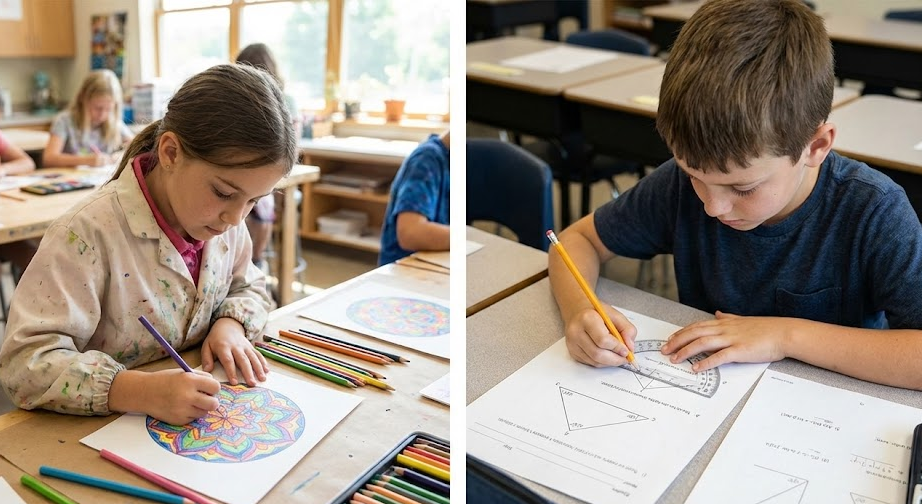
💡Example: Spotting symmetrical patterns in art class or measuring the angles of a triangle in a worksheet.
Measurement
Measure length, weight, and capacity using standard units (meters, liters, grams, etc.)
Compare objects based on measurement (longer, shorter, heavier, lighter)
Solve perimeter and area problems, especially with rectangles
Convert between units like centimeters to meters or minutes to hours
💡Example: Measuring a desk with a ruler or figuring out the area of a classroom rug.
Early algebra and logical thinking
Understand variables as symbols that represent unknown numbers
Solve simple linear equations like x + 5 = 12
Explore patterns and number relationships
Learn clever math shortcuts like the zig-zag method
See how division connects to multiplication
💡Example: Solving equations like x + 6 = 14 with confidence
How Parents Can Help 4th Graders to Learn Math
Supporting your child’s math learning at home can make a big difference. Small, everyday activities and encouragement help them build confidence, understand concepts, and even enjoy math. Here are some simple ways you can get involved:
How Parents Can Help | Examples and Tips |
|---|---|
Practice math facts | Turn memorization into a game with flashcards, timed quizzes, or fun apps. Try “math races” at the dinner table or quick mental math challenges to reinforce speed and accuracy |
Connect math to daily life | Involve your child in cooking by doubling or halving recipes, measuring ingredients, or calculating cooking times. While shopping, ask them to compare prices, calculate discounts, or total costs. Plan activities together and explore distance, time, or quantities in real scenarios |
Encourage explanation | Ask your child to explain their reasoning: “How did you solve this?” or “Can you show a different way?” Encourage drawing diagrams, writing steps, or using objects to visualize problems. This builds critical thinking and deeper understanding |
Celebrate achievements | Praise effort, persistence, and creative problem-solving, not just correct answers. Keep a “math success” board or journal to track progress and celebrate tricky problems they solved. Small rewards like picking a favorite snack or activity can reinforce motivation |
Making Math Click for Your Child
Every child approaches math differently, and the journey can have its ups and downs. What matters most is celebrating progress, encouraging curiosity, and turning mistakes into learning moments. When math feels approachable and interactive, children start trusting their own problem-solving skills and feel proud of what they can achieve. Give your child that extra edge with Bhanzu, where learning math becomes fun, interactive, and confidence-boosting. Book a demo now to get started.
Was this article helpful?
Your feedback helps us write better content