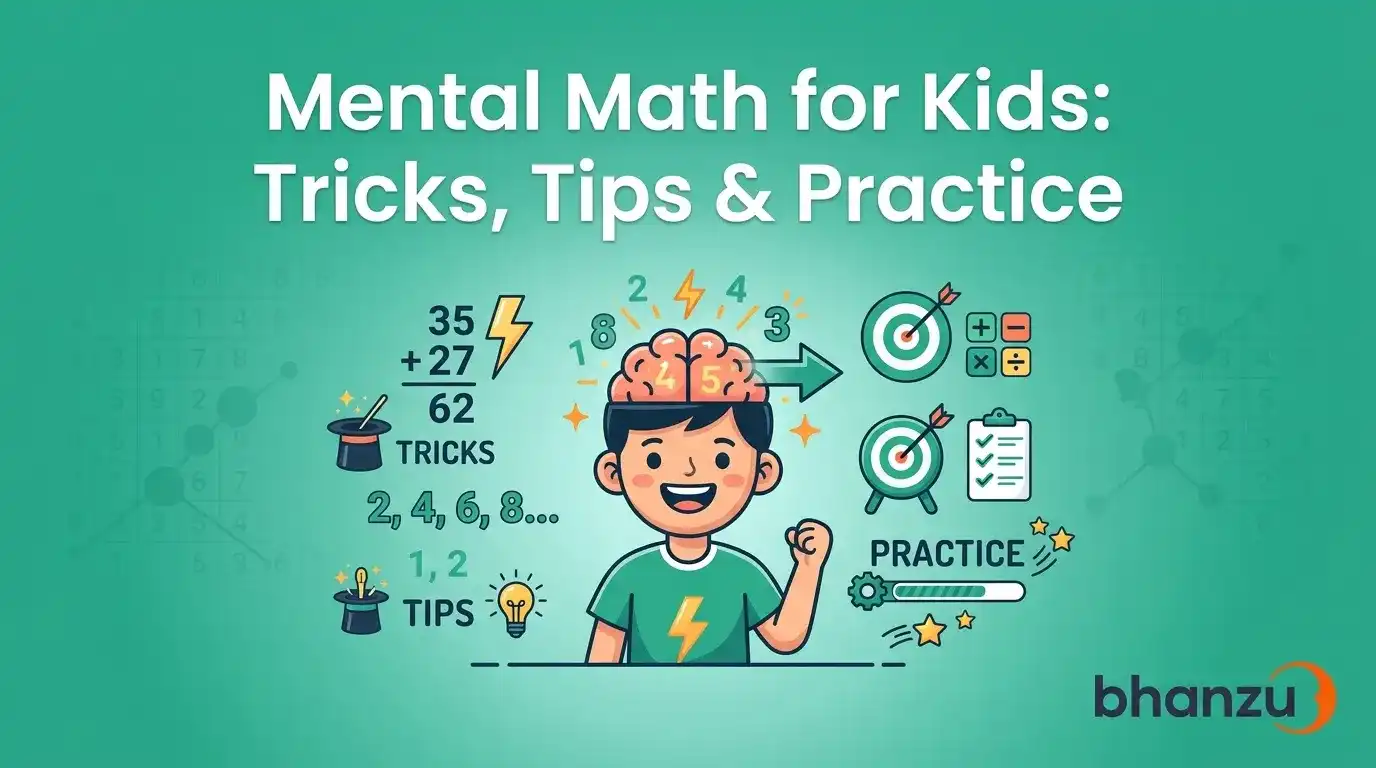
Most parents assume mental math is a parlour trick. Something prodigies do, ordinary kids can't, and the rest of us reach for a calculator. That assumption is the first thing to drop. Mental math isn't speed. It's flexibility - the ability to spot a friendlier number nearby, reshape the problem, and arrive at the answer through a different door. It's how mathematicians actually think.
The four most useful mental math tricks for any child to learn are: rounding-and-adjusting, multiplying by 11, finding 10% of any number, and making 10s when adding small numbers. Those four cover most everyday calculation a Grade 4 child will need to do mentally.
Here's what almost no other guide on the internet does, and what makes the difference between a child who memorises tricks and a child who understands them. Every trick rests on a real mathematical principle: Distribution, Place value and Compensation. If your child knows the principle, they can derive most tricks themselves. If they only know the trick, the trick breaks the moment the numbers shift slightly.
What Mental Math Actually Is (And What It Isn't)
Mental math isn't a special skill some children are born with and others aren't. It's a set of strategies. The strategies are learnable.
What mental math is not: it's not faster paper math done in your head. A child who tries to "stack" 47 + 38 vertically in their imagination and carry the 1 mentally will run out of working memory by the time they hit three-digit numbers. Mental math works because it sidesteps the paper algorithm entirely.
What it actually is: number sense. The ability to break numbers apart by place value (47 = 40 + 7), notice that one number is close to a friendlier one (38 is close to 40), and use that to make the calculation easier (47 + 40 = 87, then – 2 = 85). Three small steps. No carrying.
Worth saying twice in this article, because it matters: the reason this matters is that algebra later asks the same skill. Rearranging numbers, substituting easier values, working flexibly. That's exactly what algebra does, just with letters in place of digits. Children who develop number sense early have an easier time with algebra. Not because they're smarter. Because they're already used to the move.
How We Picked These 15 Tricks
The internet has a lot of mental math lists. Most are fine. Most are also missing the same things: grade banding, the underlying math, common mistakes, and how a parent without a math background can actually teach them.
We picked these 15 against six rules:
Foundation-first. Tricks that build number sense beat tricks that just impress.
Wide grade coverage. From Grade K make-10s to Grade 8 percentage shortcuts.
Real classroom evidence. These are tricks our trainers use in live sessions, not curiosities pulled from old books.
Underlying math is teachable. Each trick rests on a real principle (distribution, compensation, place-value), not a quirky pattern that breaks at scale.
Common-mistake-aware. Every trick has a known failure mode. We list it.
Parent-applicable. A parent without a math background must be able to teach it tonight.
Quick Comparison Table — All 15 Mental Math Tricks at a Glance
# | Trick | Operation | Best Grade | Difficulty | Use When… |
|---|---|---|---|---|---|
1 | Make-10s | Addition | K–2 | Easy | Adding small numbers near 10 |
2 | Add Left to Right | Addition | 2–4 | Easy | Two-digit and larger sums |
3 | The +9 Trick | Addition | 1–3 | Easy | Adding 9 to anything |
4 | Doubles and Near-Doubles | Addition | 1–3 | Easy | Adding two close numbers |
5 | Subtract from 100 / 1,000 | Subtraction | 3–5 | Medium | Counting change |
6 | Round and Adjust | Add / Multiply | 3–5 | Medium | Numbers near a "round" friend |
7 | Multiply by 9 | Multiplication | 3–4 | Easy | Any number × 9 |
8 | Multiply by 11 | Multiplication | 4–5 | Medium | Two-digit × 11 |
9 | Multiply by 5 | Multiplication | 3–5 | Easy | Even number × 5 |
10 | Break Apart and Multiply | Multiplication | 4–6 | Medium | Two-digit multiplication |
11 | Double and Halve | Multiplication | 5+ | Hard | Pairs like 16 × 25 |
12 | Square Numbers Ending in 5 | Multiplication | 6+ | Medium | 25², 35², 45²… |
13 | Divide by 5 | Division | 5+ | Easy | Quick division |
14 | Find 10% | Percentage | 5+ | Easy | Tips, discounts, estimates |
15 | Estimate First | All | All | Easy | Every problem, before solving |
Foundational Tricks (Grades K–3)
1. Make-10s — The Foundation of All Mental Addition
Best for: Grade K–2, addition
When a child is asked to add 8 + 6, the slow way is to count up from 8 on fingers. The fast way is to break the 6 into 2 + 4, give the 2 to the 8 (which makes 10), then add the leftover 4. Answer: 14.
Worked example: 8 + 6 → 8 + 2 = 10, then 10 + 4 = 14.
Why it works: This is number bonds and place value combined. Tens are friendly numbers, easy to add to. Breaking one number into "what gets you to 10" and "what's left" turns a hard addition into two easy ones.
Common mistake: Children who haven't internalised the partners of 10 (2+8, 3+7, 4+6, 5+5) can't break the second number quickly enough. They fall back to counting on fingers, and the trick stops being faster.
How to teach it: Drill the partners of 10 first using a ten-frame or fingers grouped in fives. Once those are automatic, the make-10 trick clicks within a session or two.
2. Add Left to Right — How Mathematicians Actually Add
Best for: Grade 2–4, addition
On paper, we add right to left because that's how the carrying algorithm works. In the head, the opposite is faster: start with the biggest place value and work down.
Worked example: 34 + 17 → 30 + 10 = 40, then 4 + 7 = 11, then 40 + 11 = 51.
Why it works: Place-value decomposition. The tens are the bigger contribution; getting them out of the way first means there's less to track in working memory.
Common mistake: Children who've only ever done paper addition try to imagine the columns and "carry the 1" mentally, then run out of working memory by the time they hit three-digit numbers.
How to teach it: Practise out loud. "Thirty plus ten is forty… four plus seven is eleven… forty plus eleven is fifty-one." Saying the steps slows the brain down enough to build the new habit.
3. The +9 Trick — Add 10, Then Step Back One
Best for: Grade 1–3, addition
Adding 9 is harder than adding 10, but only because we treat it as a separate problem. It isn't. 9 is just 10 minus 1.
Worked example: 47 + 9 → 47 + 10 = 57, then 57 – 1 = 56.
Why it works: Compensation principle. You replace the awkward number with a friendlier one, do the easier calculation, then undo the change. This is one of the most useful general moves in mental math.
Common mistake: Forgetting to subtract the 1 at the end. Kids get to "57" and stop, because 57 feels like a finished answer.
How to teach it: Use a number line. Two big jumps forward (10), one tiny step back. The visual sticks better than the rule.
4. Doubles and Near-Doubles — Build From What's Already Known
Best for: Grade 1–3, addition
Doubles (4+4, 7+7, 8+8) are easier to memorise than other addition facts because the two numbers are the same. There's only one digit to remember. Near-doubles (7+8, 6+7) are then "double plus one" or "double minus one."
Worked example: 7 + 8 → "I know 7 + 7 = 14, so 7 + 8 = 15."
Why it works: Anchoring plus compensation. The child anchors on something they know (the double), then adjusts.
Common mistake: Doubling the wrong number. For 7+8, some kids double the 8 (=16) and then subtract 1 (=15). The math still works, but the more reliable habit is to always double the smaller number and add the difference.
How to teach it: Drill doubles to automaticity first (1+1 through 10+10). Then introduce near-doubles as a second move.
5. Subtract from 100 or 1,000 — The 9-9-10 Rule
Best for: Grade 3–5, subtraction
Subtracting from a round number like 1,000 is a regrouping nightmare on paper. Mentally, there's a faster way: subtract every digit from 9, except the last digit, which you subtract from 10.
Worked example: 1,000 – 764 → 9 – 7 = 2, 9 – 6 = 3, 10 – 4 = 6 → answer is 236.
Why it works: It's a counting-up shortcut in disguise. To get from 764 to 1,000, you need 236. The 9-9-10 pattern is what falls out when you split 1,000 into 999 + 1.
Common mistake: Subtracting all three digits from 9 (giving 233 instead of 236). The 10 at the end is non-negotiable. It accounts for the +1 we used to make the math work.
How to teach it: Drill it with shopping change. "If something costs 764 and you pay 1,000, what's the change?" Real-world context locks the pattern.
Intermediate Tricks (Grades 3–5)
6. Round and Adjust — The Compensation Method
Best for: Grade 3–5, addition and multiplication
This is the single most useful trick on this list. It's the +9 trick scaled up: round any awkward number to a friendly one, calculate, then undo the rounding.
Worked example (addition): 644 + 238 → round to 650 + 240 = 890. We added 6 + 2 = 8 in the rounding, so subtract 8: 890 – 8 = 882.
Worked example (multiplication): 59 × 7 → round to 60 × 7 = 420. We added one extra 7 in the rounding, so subtract: 420 – 7 = 413.
Why it works: Compensation. Change the numbers, track the change, undo the change. Same logic as the +9 trick, applied to bigger numbers and other operations.
Common mistake: Forgetting which direction to adjust. Kids round up and then add at the end (instead of subtracting), or round down and subtract (instead of adding). The fix isn't memorisation. It's writing down the "I owe / I'm owed" amount on a fingertip.
How to teach it: Always have your child say out loud what they changed. "I added 6 to the first number, so I owe 6 at the end." Verbalising the change builds the tracking habit.
7. Multiply by 9 — The "10 Minus 1" Method
Best for: Grade 3–4, multiplication
Multiplying by 10 is trivial. You add a zero. So 9 × 7 becomes "10 × 7 minus 7."
Worked example: 9 × 7 → (10 × 7) – 7 = 70 – 7 = 63.
Why it works: This is the distributive property in action: 9x = (10 – 1)x = 10x – x. The same algebraic move kids will see in Grade 7.
Common mistake: Subtracting the wrong factor. For 9 × 7, some children compute 70 – 9 = 61 instead of 70 – 7 = 63. They subtract the "9" because that's what they're multiplying by, but the correct subtraction is the other number.
How to teach it: The finger method also works (hold up ten fingers, bend the 7th, count 6 fingers left = 60 and 3 fingers right = 3, answer 63). Show both. Some kids prefer the algebra; others prefer the fingers. Either way, by the end of Grade 4 they should understand both.
8. Multiply by 11 — The Split-and-Add Trick
Best for: Grade 4–5, multiplication
This trick feels like magic when it lands. To multiply any two-digit number by 11, write the two digits with a gap, then add them and put the result in the gap.
Worked example: 11 × 25 → split as 2 _ 5, add 2 + 5 = 7, fill the gap → 275.
Why it works: Distributive property again. 11x = 10x + x. So 25 × 11 = 250 + 25 = 275. The "split and add" is just shorthand for that.
Common mistake: Forgetting to carry when the inner sum is 10 or more. For 11 × 88: 8 + 8 = 16. The answer isn't 8168. It's 968, because you carry the 1 into the tens place.
How to teach it: Start with examples where the digits sum to less than 10 (12, 23, 34, 45). Once that's solid, introduce a "carry" example like 76 × 11 or 88 × 11. The two-step rollout prevents the most common error.
9. Multiply by 5 — Halve It, Then Multiply by 10
Best for: Grade 3–5, multiplication
Multiplying by 5 is easier than it looks because 5 is half of 10. So 48 × 5 is the same as half-of-48 × 10.
Worked example: 48 × 5 → halve 48 = 24, ×10 = 240.
Why it works: 5 = 10 ÷ 2, so multiplying by 5 is the same as multiplying by 10 and dividing by 2. (Order doesn't matter. You can halve first and then ×10, or ×10 first and then halve. Halving first usually keeps the numbers smaller.)
Common mistake: Halving odd numbers and getting stuck. For 47 × 5, half of 47 is 23.5, which feels wrong to a Grade 3 child. The fix: 47 × 5 = (46 × 5) + 5 = 230 + 5 = 235.
How to teach it: Teach the rule with even numbers first (24, 36, 48, 60). After the trick is automatic, introduce odd-number cases as a Grade 4–5 extension.
10. Break Apart and Multiply — The Distributive Trick
Best for: Grade 4–6, multiplication
This is the most important trick on this list, and the one most worth investing in, because it's the same move that powers algebra later.
Worked example: 24 × 13 → split 13 into 10 + 3. Then (24 × 10) + (24 × 3) = 240 + 72 = 312.
Why it works: Distributive property: a(b + c) = ab + ac. This is what algebra teaches in Grade 7 with letters; the trick teaches it in Grade 4 with numbers.
Common mistake: Adding the two intermediate products incorrectly. The math is right; the working memory fails. Kids get to "240 and 72" and then can't hold both numbers while adding.
How to teach it: Have your child say each intermediate product out loud and write it down. Yes, on paper. This trick is mental, but the intermediate steps can be supported. After enough practice, the working-memory load drops and the paper isn't needed.
Advanced Tricks (Grades 5–8)
11. Double and Halve — Reshape the Problem
Best for: Grade 5+, multiplication
Multiplication has a hidden symmetry: if you double one factor and halve the other, the product is unchanged. That means you can reshape ugly multiplications into pretty ones.
Worked example: 16 × 25 → halve 16 (= 8), double 25 (= 50). Now 8 × 50 = 400. Much easier than the original.
Why it works: ×2 and ÷2 cancel. So (a × 2) × (b ÷ 2) = ab. The product stays the same; the calculation gets easier.
Common mistake: Doubling and halving in the wrong direction, making the problem harder, not easier. The rule of thumb: halve until one number becomes friendly (5, 10, 50, 100), and double the other to compensate.
How to teach it: Show three examples where this works beautifully (16 × 25, 14 × 50, 18 × 5). Then show one example where it doesn't help (17 × 23, where neither halving nor doubling gets you to a friendly number) so your child learns when to reach for it and when not to.
12. Square Numbers Ending in 5 — The "n × (n+1)" Pattern
Best for: Grade 6+, multiplication
To square any number ending in 5, take the digit before the 5, multiply it by the next number up, and append "25" to the end.
Worked example: 35² → take the 3, multiply by 4 (the next number) = 12, append 25 → 1,225.
Another: 65² → 6 × 7 = 42, append 25 → 4,225.
Why it works: Algebraic identity. (10n + 5)² = 100n² + 100n + 25 = 100n(n + 1) + 25. The "n × (n+1)" gives the hundreds-and-thousands part; the "25" is what's left from squaring the 5.
Common mistake: Trying to apply this to numbers that don't end in 5. The pattern relies on the +25 that comes from squaring the 5. Without that, the rule breaks.
How to teach it: For older kids who've seen algebra, show the derivation once. For younger kids, just teach the pattern and let them verify it works on a calculator. Both approaches build confidence.
13. Divide by 5 — Double, Then Divide by 10
Best for: Grade 5+, division
Same logic as multiplying by 5, run backwards. To divide by 5, double the number and then divide by 10.
Worked example: 85 ÷ 5 → 85 × 2 = 170, then 170 ÷ 10 = 17.
Why it works: ÷5 is the same as ×2 then ÷10, because 5 = 10 ÷ 2.
Common mistake: Doubling and forgetting to divide by 10, getting an answer that's ten times too big. (A child who confidently announces "85 ÷ 5 = 170" has done half the work and stopped.)
How to teach it: Teach this immediately after the "multiply by 5" trick. They share the same logic, and teaching them together cements the underlying principle.
14. Find 10% — Just Move the Decimal
Best for: Grade 5+, percentages
Finding 10% of any number is the simplest percentage shortcut, and the foundation for finding most other percentages.
Worked example: 10% of 235 → move the decimal one place left → 23.5.
Why it works: 10% means "divide by 10." In base-10, dividing by 10 shifts every digit one place to the right (which is the same as moving the decimal point one place to the left).
Common mistake: Moving the decimal in the wrong direction. Some children move it right (multiplying by 10 instead of dividing) and end up with an answer 100 times too big.
How to teach it: Anchor with money. "10% of 80 rupees is 8 rupees. 10% of 80 dollars is 8 dollars. Move the decimal once. That's it." Once 10% is automatic, build outward: 5% is half of 10%; 20% is double; 25% is half-of-half. The whole percentage system unlocks from this one move.
15. Estimate First, Calculate Second — The Sense-Check Habit
Best for: All grades, all operations
This isn't a trick. It's a habit. And it's the most underrated skill on this list.
Worked example: 198 × 23 → "Roughly 200 × 23 = 4,600. So my answer should be near 4,600. If I get 460 or 46,000, something went wrong."
Why it works: Order-of-magnitude reasoning. You're not finding the exact answer with the estimate. You're putting a fence around what the right answer must look like. Anything outside the fence is a sign of an arithmetic slip or a calculator misclick.
Common mistake: Skipping the estimate because "I'll just calculate it." Kids do the calculation, get a wrong answer, and trust it because they have nothing to compare it to.
How to teach it: Make estimation the first thing your child does. Before they reach for an answer, before they touch a calculator. Even a three-second "is this answer going to be in the hundreds or the thousands?" catches most arithmetic mistakes.
How to Teach Mental Math at Home (Without Becoming a Math Tutor)
Most parents feel underqualified to teach math, especially if their own math education was a series of memorised algorithms with no underlying intuition. Here's the thing: you don't need to be a math person. You need to slow down, ask good questions, and let your child do the thinking. Five rules:
Teach one trick at a time. Don't introduce the rounding method and the double-and-halve method in the same session. Pick one, drill it for a week, then add the next. Trying to layer five tricks in a weekend confuses the child and consolidates none of them.
Praise the method, not the answer. "I love how you rounded up first" is more useful than "Good job." It tells the child what to repeat. The answer is downstream of the method; the method is what you want to reinforce.
Keep sessions short. Five to ten minutes a day beats forty-five minutes on Sunday. Short, frequent practice is how working memory builds. Long sessions just create math fatigue.
Use real-life contexts. Pocket money. Cricket match runs. Pizza slices. Distance to school. Time left in a video game. The trick works just as well with abstract numbers, but the child cares more when the numbers are theirs.
Don't ban the calculator. Just delay it. "Estimate first, then check on the calculator" builds the sense-check habit (Trick 15). The calculator becomes a verification tool rather than a substitute for thinking.
When Mental Math Trouble Signals Something Deeper
Mental math tricks help children who already have the foundation. They don't fix children who don't. Here are signs your child's mental math struggles point to something underneath:
Counts on fingers past Grade 3 for single-digit addition. This isn't a fingers problem; it's a number-bond gap. The make-10s and partners-of-10 weren't built into automaticity at the right age.
Refuses to estimate before solving. A child who insists on "calculating exactly" before even attempting to estimate is usually showing confidence collapse. They're afraid of being wrong, so they avoid the move that exposes their thinking.
Gets right answers but can't explain how. Fragile understanding. The algorithm got memorised; the reasoning didn't. This breaks at the next grade level when the algorithm changes.
Adds denominators when adding fractions. This isn't a fraction issue. It's a place-value issue dressed up. The child doesn't see the denominator as a "size of piece"; they see it as another number to add.
Memorises tricks but freezes when numbers change slightly. The classic sign that the why was never taught. The trick works for the example numbers; the principle was never internalised.
If two or more of these sound familiar, your child likely has a foundation gap, not a mental math gap. The 15 tricks above will still help. They won't fix what's underneath.
How Bhanzu Approaches Mental Math
Mental math tricks rest on a foundation. Bhanzu builds the foundation first.
Every Bhanzu student, regardless of school grade, starts with a Level 0 diagnostic. The diagnostic finds where the child's actual math is, not where their school grade says they should be. A Grade 6 student with gaps in Grade 3 fraction work gets reset to Grade 3 and rebuilt from there. The mental math tricks emerge from concept teaching, not the other way around. A child who understands the distributive property doesn't need to memorise the multiply-by-11 trick. They can derive it.
The structure: live trainers, small groups, an 18-month program built around Socratic teaching (WHY before WHAT and HOW). Tricks aren't taught as standalone moves; they're taught as natural consequences of the principles underneath. Across 70,000+ students and 6 million teaching hours, the pattern is consistent: children who learn principles outlast children who learn tricks.
Was this article helpful?
Your feedback helps us write better content