As parents, it is hard for us to watch our children struggle with math, especially when we want to help but do not quite grasp how to make math fun for kids. Seeing our kids struggle with math reminds us of our own challenges as students.
If this sounds familiar, you’re not the problem, and neither is your child. The root of the issue lies in how math is being taught to our children.
Where Are We Going Wrong With Math?
A recent study shows that nearly 49% of middle and high school students lose interest in math class half the time or more, and many have already decided they’re just not “math people.”
The issue isn’t that our curriculum lacks rigor or global relevance. The problem, very often, lies in how math is taught. The Common Core standards, for example, were designed to deepen understanding and connect math to real life. While the intent was strong, many parents and educators have observed that the defined objectives were not met in practice. Globally, it is usually the implementation of the curricula that becomes a key differentiator, rather than the design itself.
Here's what tends to go wrong:
Students are rushed through the fundamental concepts without being given enough time to practice and build confidence.
Lessons often focus on copying steps instead of understanding why they work.
Large class sizes leave little room for questions or creative thinking.
Test preparation is prioritized over building a strong foundation, leading to more worksheets and less engagement.
When students are given time, space, and encouragement, they thrive. They need chances to explore different methods, ask “why,” and connect math to the world around them. Once they understand and feel supported, their confidence grows, and their belief in their own ability follows.
How to Make Math Fun and Engaging for Your Child?
So how does one go about making math fun? We have put together a list of three ways to help achieve this.
1. Show There’s More Than One Way to Solve Problems
In many classrooms, math feels like, "Copy. Repeat. Move on.” Students blindly follow the teacher’s method without enquiring if there’s another possible approach.
But in math, there’s rarely just one path to the answer. Trying different methods keeps learning fun, builds confidence, and strengthens mental agility.
For example, let's look at addition:
Most of us were taught to add from right to left. But did you know, you can also add from left to right, with a faster, more intuitive approach called the L–R method:
So, if we want to add 47 and 36, we do it in 3 steps,
We add the tens first: 40 + 30 = 70
We add the ones next: 7 + 6 = 13
Then we combine the results: 70 + 13 = 83
Same answer, different path! Each new path strengthens your child’s number sense — their natural feel for how numbers connect.
At Bhanzu, we love introducing students to speed math techniques like the L–R method. This makes math feel like a game or a fun strategy. Soon, students start seeing numbers as tools they can play with — and that’s when their confidence and curiosity take off.
2. Turn Screen Time Into Math Time with Friends!
Screen time does not necessarily have to translate to endless scrolling and distractions. In fact, limited screen time can actually be productive if deployed the right way.
Research shows that gamified learning helps improve academic outcomes and provides children with the motivation to stay engaged by tapping into their innate need to feel competent and capable.
The Bhanzu Play app helps children build math confidence, improve their speed and accuracy, and have fun while learning. Here are a few things they can do:
Have math duels in real time with players at their level
Challenge their friends to see who’s the math champ and climb leaderboards!
Practice key concepts through timed questions
Suddenly, conquering math problems feels like a huge win! This approach incentivizes children to practice on their own and solidify their learning.
3. Experience Math With Everyday Activities
How many times have you stared at a parabola on the worksheet and thought, “What’s the point of this?” It felt too abstract — and you were pretty sure you’d never use it.
Chances are, your child feels the same when math is taught without any real-world connection, but what if you showed them that math is part of everyday life? Here are a few possible scenarios:
At the grocery store, give your child a budget and the shopping list, and then ask them to pick items that fit. This is a real-time exercise in mental math, estimation, and smart decision-making.
While cooking breakfast, ask: “If this recipe makes 4 pancakes and we need to serve 6 people, how should we adjust the amounts?” It gets them thinking about multiplication, scaling, and logic.
When you’re rearranging the furniture, ask your child to help measure the area of a rug or evaluate if the new bookshelf will fit in the corner. That’s geometry in action, but with a tape instead of a textbook.
These small moments turn math from abstract to useful, practical, and even fun. You can build on them by letting your child learn math with us, or by trying a few activities from our free learning pack.

When Math Comes to Life, Confidence & Clarity Follows
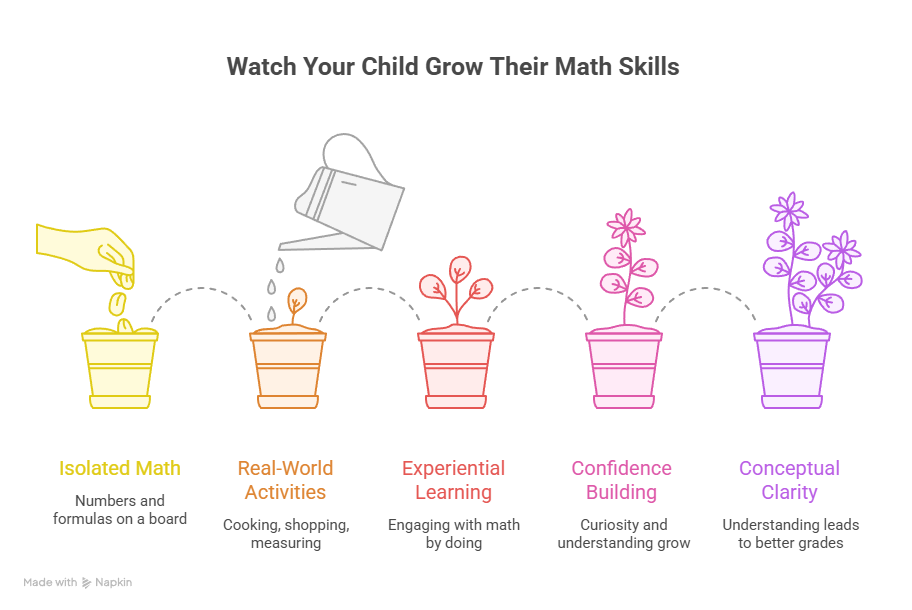
For the longest time, math has been taught in isolation: numbers on a board, formulas in a notebook, far removed from real life. But when you start participating in math activities with your child, such as cooking, shopping, and measuring things around the house, you’ll notice something shift.
Children begin to understand math by engaging with and applying it. Gradually, they start to build confidence. You’ll hear fewer “I’m not a math person” statements. They will express greater curiosity about how things work. That’s when you know it’s working. Because math isn’t just for the math people, it’s for everyone!
Was this article helpful?
Your feedback helps us write better content