
Your child can multiply 8×7 in seconds. But when homework asks, "A recipe calls for 7 cups of flour to make 8 batches. How much for one batch?" they freeze. Same numbers. Different question. No connection.
This gap happens when kids learn math as isolated tricks instead of connected ideas. Many children struggle with math, but the right approach helps them see how multiplication links to division, fractions connect to decimals, and patterns repeat across problems, making numbers meaningful in real life.
Why Isolated Practice Limits Problem-Solving
When children practice multiplication separately from division, they miss how these concepts connect. A child might know that 8×7=56 and 56÷7=8, yet not realize these represent the same relationship from different angles.
This gap becomes clear during problem-solving: your child knows the steps but struggles to decide which to use, because they’ve learned these as separate skills rather than linked ideas.
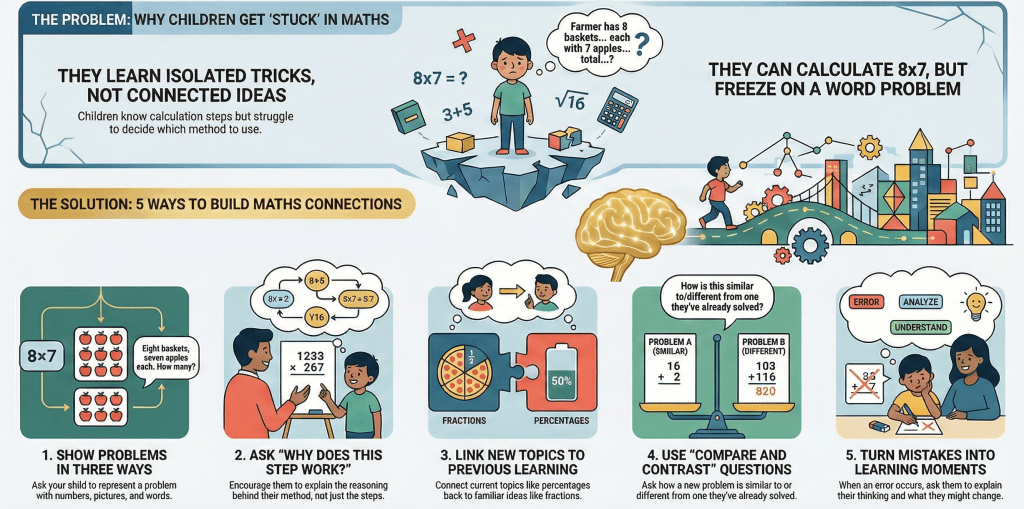
The solution lies in showing your child how math ideas link together. Here are five simple strategies you can use to help your child make these links and see math as one coherent system.
5 Ways to Build Math Connections
Small changes in how you practice create big differences in understanding.
1. Show Problems in Three Ways: Numbers, Pictures, Words
Ask your child to solve a problem in three formats: drawing, equation, and sentence.
Example for "12÷3=4":
Equation: 12÷3=4
Picture: Draw 12 circles in 3 groups of 4
Words: "Twelve items split into three equal groups give four per group"
Success indicator: Your child explains the solution in at least two ways without prompts.
2. Ask "Why Does This Step Work?"
Encourage reasoning, not just steps.
Example: “We multiply by 3 to make both parts bigger by the same amount, so the value stays the same.”
Success indicator: Your child explains reasoning in 3 out of 5 problems.
3. Link New Topics to Previous Learning
Connect current homework to earlier ideas. When learning percentages, remind them that 50% equals ½ or 0.5.
Example: "Remember doubling from last month? That's the same as multiplying by 2."
What success looks like: Child uses a previous idea correctly in a different context at least twice weekly.
4. Use "Compare and Contrast" Questions
Ask, "How is this like the last problem? What's different?" This trains pattern recognition.
Example: "Both problems have fractions, but this one asks us to add them instead of multiplying."
What success looks like: The Child picks the right method within 30 seconds of reading the problem.
5. Turn Mistakes into Learning Moments
After errors, ask them to explain their thinking. "What did you try first? What would you change?"
Example: "You multiplied here. What does 'less than' usually mean in math?"
What success looks like: Child tries to fix their own mistakes without help in 4 out of 5 similar problems.
These shifts work even better when turned into regular activities. Here's how:
3 Family Activities That Build Connections
Try these 10-minute sessions using materials you already have at home.
Activity 1: Map the Problem
What you need: Sticky notes, paper
Write a math problem. Have your child create three sticky notes: one with the equation, one with a drawing, and one with a sentence explanation. Discuss how each shows the same idea.
What success looks like: Child creates correct representations 4 out of 5 times and uses this method for new problems twice weekly.
Activity 2: Child Teaches Parent
What you need: Whiteboard or tablet
Your child explains a solved homework problem as if teaching you. Ask "why" and "what if" questions. Let them defend or adjust their reasoning.
What success looks like: Child explains without hesitation and needs fewer hints over 2 sessions.
Activity 3: Connection Journal
What you need: Small notebook
For one week, have your child write one math connection daily. Examples: "Adding is like combining groups" or "Division is backwards multiplication." Review together on Sunday.
What success looks like: Child writes 5 entries in a week and refers back to one during homework.
Quick Tips:
Use color-coding: green for pictures, blue for equations. This visual system helps children recognize different ways to show the same idea.
Run these activities twice weekly. Repetition builds habits while variety keeps things interesting.
From Memorization to Mathematical Thinking
With each activity, you'll see a big change. Your child will recognize patterns faster, choose strategies more confidently, and explain their thinking clearly.
They'll stop asking "Which formula do I use?" and start thinking, "Which math relationship fits this problem?" That shift from memorizing to confident mathematical thinking is the real win.
Ready to build on this new confidence with structured support? Book a free demo class to see how expert instruction can continue to strengthen your child's thinking.
Was this article helpful?
Your feedback helps us write better content