
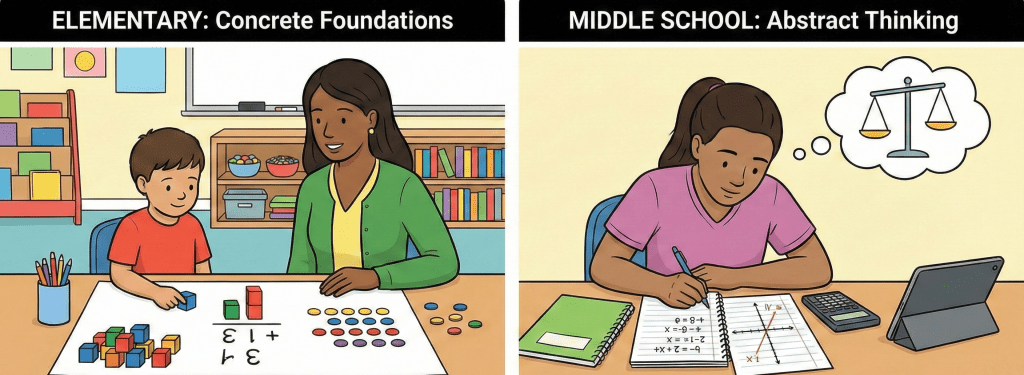
You've probably noticed that the math help that worked for your second grader doesn't work as well now that they're in seventh grade. That's because effective pedagogy in mathematics intentionally shifts as children develop.
Elementary math learning responds best to concrete exploration with objects and visuals. Middle school math needs bridges to abstract thinking and symbolic reasoning.
This guide explains the concrete differences between elementary and middle school math pedagogy, gives you short activities with measurable success indicators for each stage, and shows you when to adjust your approach.
How Math Pedagogy Shifts from Elementary to Middle School
Understanding these developmental stages helps you choose the right support strategies:
Stage | Focus | What Your Child Needs | How You Can Help |
|---|---|---|---|
Elementary (Grades K-4) | Concrete manipulatives, number sense, visual models | Hands-on exploration before symbols | Use objects to model problems; practice mental math strategies; create visual representations |
Transition (Grades 5-7) | Bridging concrete to abstract | Explicit connections between models and symbols | Show both physical and symbolic solutions; explain "what it means" |
Middle School (Grades 6-8) | Symbolic reasoning, algebraic thinking, justification | Abstract thinking with understanding | Link symbols to visuals first; encourage generalization; ask for explanations |
Critical mathematics pedagogy research shows that matching teaching methods to developmental stage significantly impacts both comprehension and confidence.
A. Elementary: Build Number Sense with Hands-On and Visuals
Use small sets of objects: Model addition and subtraction with coins, buttons, or blocks. Ask your child to show "one more" or "take away" physically before writing a number sentence.
Prioritize mental strategies: Practice decompositions with quick oral drills. Ask "What are different ways to make 10?" for 30 to 60 seconds.
Success indicator: Your child lists 8 decompositions in 90 seconds with 80% accuracy.
Create visual models: Sketch bar models or number lines together. Require your child to explain "why" their solution works for one problem per session.
B. Middle School: Shift to Abstract Reasoning and Justification
Link symbols to visuals: When algebra appears, ask your child to draw a balance or concrete representation first, then translate to symbols.
Success indicator: Your child solves 4 variable equations by producing both a sketch and a correct symbolic solution in 10 minutes with 75% accuracy.
Teach "what it means" questions: Regularly ask "What does this variable represent?" and "How would you test if this is correct?"
Behavioral indicator: Your child starts asking themselves these questions during homework by week two.
Encourage generalization: Have your child create a short rule after solving 2 to 3 similar problems.
Quick Decision Framework for Choosing the Right Approach
You can use this checklist during homework or when selecting practice materials.
Step 1: Identify the task level
Concrete manipulation needed? Use elementary tactics (objects, visuals, story contexts)
Symbolic manipulation required? Use middle school tactics (abstract reasoning, justification)
Step 2: Use the 3-question test
Can they model it with objects or drawings?
Can they write the rule or procedure?
Can they explain why it works?
Step 3: Structure your time
10 minutes guided modeling with you
10 minutes independent practice
When to seek extra help: Progress stalls after 3 weeks of targeted practice, or emotional resistance goes beyond normal hesitation.
Two Activities You Can Try Tonight
These ready-to-run activities implement the frameworks above with measurable outcomes.
Activity A: Elementary "Make 10" Jar
Materials: 20 small counters (buttons, pennies), cup
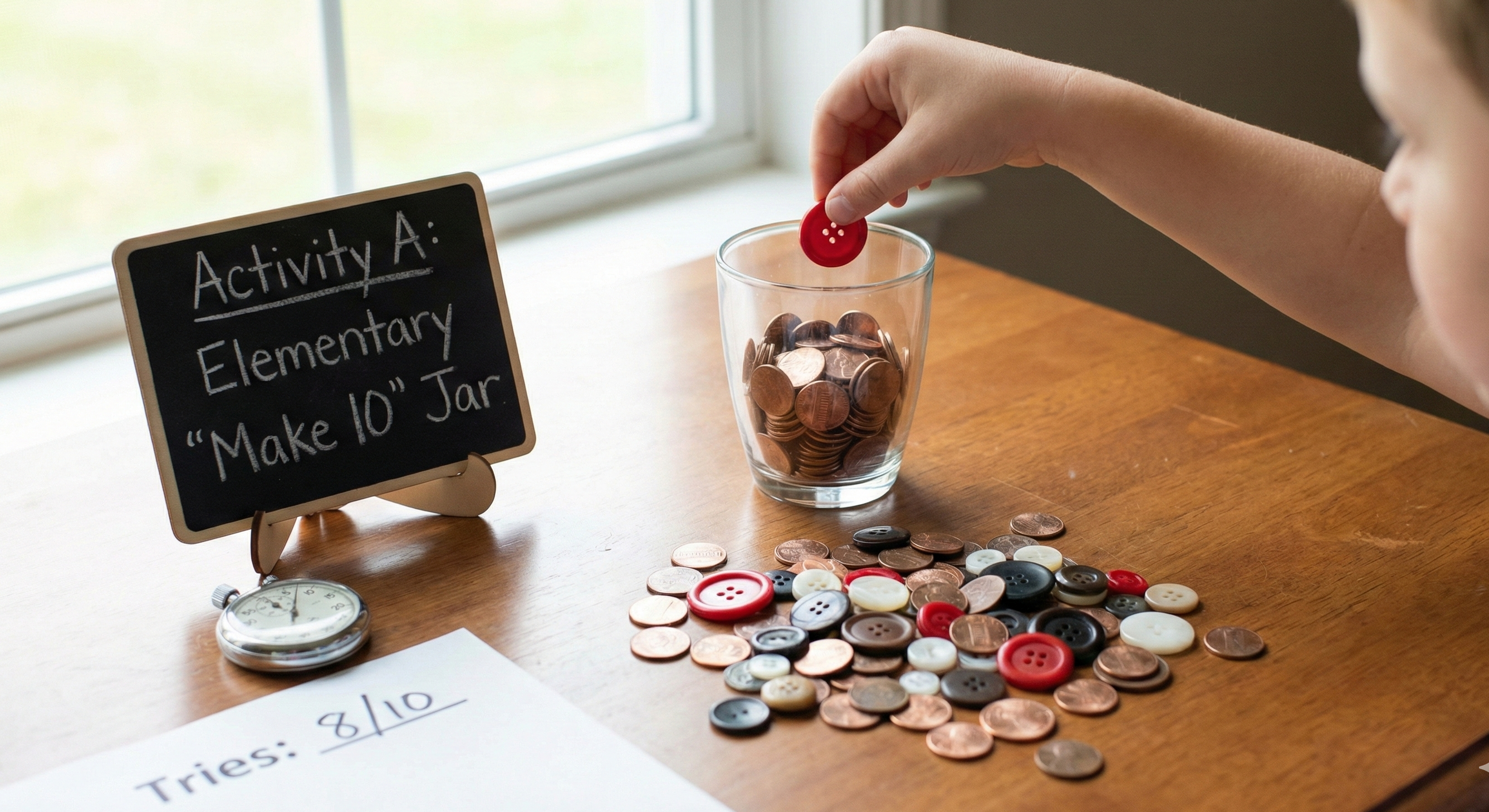
Steps:
Place a random number of counters (1-9) in the cup
Ask your child to guess how many more to reach 10
Let them add counters to check
Repeat for 10 tries in 60 seconds
Success indicator: Your child gets 8 out of 10 correct within 60 seconds, or verbalizes decomposition strategy for at least 6 tries.
Activity B: Middle School Mini Balance Lab
Materials: Two plates, small objects of equal weight, pencil and paper
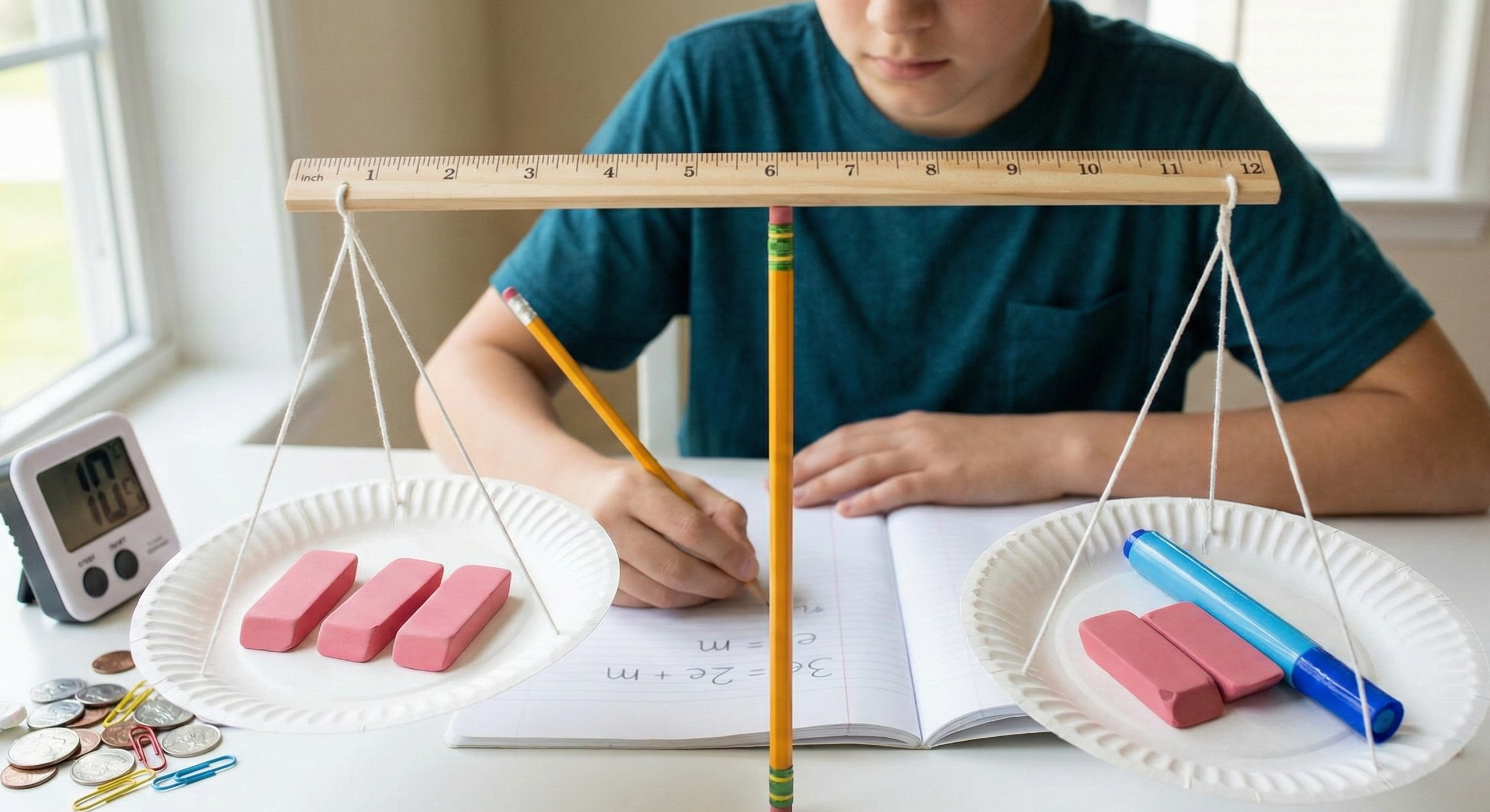
Steps:
Create a simple "equation" by balancing objects (3 erasers = 2 erasers + 1 marker)
Have your child translate to symbolic equation (3x = 2x + 1)
Solve by removing equal amounts from both sides
Attempt 4 problems in 12 minutes
Success indicator: Your child completes 3 out of 4 problems with correct translation and writes one justification explaining their steps.
Supporting Your Child's Mathematical Growth Through Targeted Pedagogy
Small shifts in how you support math homework create better outcomes than simply spending more hours. When you match your approach to your child's developmental stage, you build both understanding and confidence.
Elementary students need hands-on exploration before abstraction. Middle school students need explicit bridges from concrete to symbolic thinking. Recognizing which stage your child is in and adjusting your support accordingly makes math pedagogy work for your family.
For structured support that adapts mathematical pedagogy to your child's current level and builds bridges to the next stage, you could explore a demo class where concept-first teaching meets developmentally appropriate practice.
Was this article helpful?
Your feedback helps us write better content