
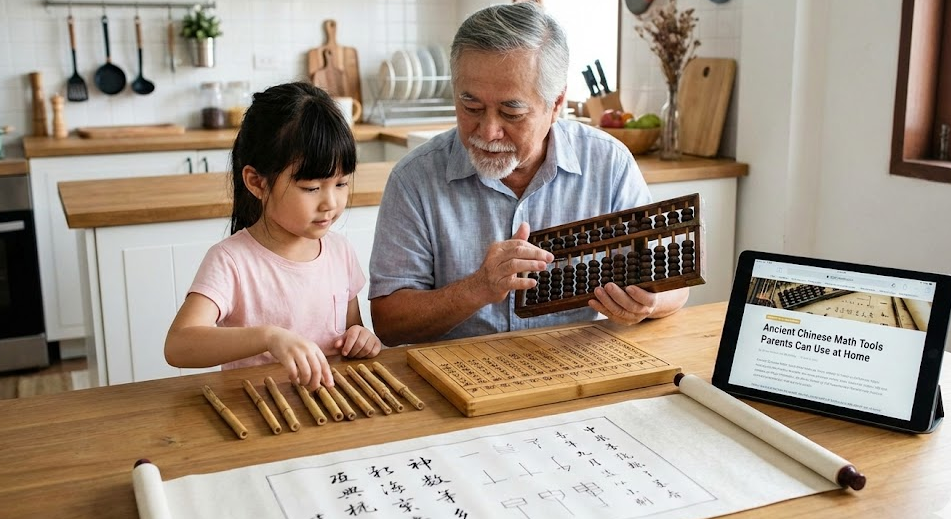
Parents often wonder why some children grasp math so intuitively while others lose confidence early on. The answer sometimes lies in how they learn, not what they learn. Centuries before textbooks and digital tools, Chinese mathematicians used real-world problems, visual patterns, and physical tools to make abstract numbers meaningful.
Today, many of these ideas are being rediscovered in classrooms and learning programs. From counting rods to tangram puzzles, these methods show that when math feels concrete, kids learn faster and think deeper.
Here's how you can bring that same clarity into your child's learning routine.
Three Ancient Chinese Techniques That Still Work Today
What made Chinese math education different wasn't just what children learned; it was how they learned to see numbers as physical objects they could move, manipulate, and master through their hands before their minds.
1. Counting Rods: The Original Place Value System
Long before base-10 blocks existed, Chinese mathematicians used counting rods. These were small bamboo sticks arranged on a counting board. But here's what made them brilliant: they didn't just count, they showed position. A rod in one column meant "ones," but the same rod one column over meant "tens."
This is the foundation of our entire number system, and Chinese children learned it by physically moving sticks around. They could see that 10 ones literally became 1 ten when moved to the next position.
How to use counting rods at home (Ages 5–8)
Use toothpicks, straws, or popsicle sticks. Draw three columns on paper: ones, tens, hundreds.
Start with 7 sticks in the "ones" column
Add 5 more. When you hit 10, bundle them with a rubber band and move that bundle to the "tens" column
Ask: "How many do we have now?" (1 ten and 2 ones = 12)
This hands-on approach makes regrouping and place value click in a way worksheets can't. Your child isn't memorizing rules: they're discovering how numbers actually work.
2. The Nine Chapters Method: Learning Math Through Real Problems
One of ancient China’s most influential math texts, The Nine Chapters on the Mathematical Art, taught math through situations. Land division, trade, sharing grain, building canals.
Every concept appeared inside a real problem that needed reasoning, not quick calculation. Children trained with this approach learn something important early. Math exists to solve real situations, not to finish worksheets fast.
How to practice the abacus at home (Ages 5–7)
Use real objects your child can touch. Pick toys, fruits, socks, or crayons. Say, “We have 12 crayons and 3 cups. Let’s make sure each cup looks the same.”
Start with placing, not counting. Ask your child to put one item in each group, going around in a circle. Only count after everything is placed.
Ask simple thinking questions like, “What should we do first?” or “Does every group look fair?” Avoid asking for the number immediately.
Let them show before they say. If your child struggles to explain, say, “Show me what you mean.” Acting it out is enough at this age.
Draw what they did. Ask them to draw circles for groups and dots for objects. Do not correct the drawing. Let it match their thinking.
Change just one thing. After solving, change one number. “What if we had one more crayon?” This builds flexibility without confusion.
3. Tangrams: Geometry You Can Touch
Tangrams are seven geometric pieces (5 triangles, 1 square, 1 parallelogram) that form a square. This 2,000-year-old Chinese puzzle teaches spatial reasoning, fractions, and geometric relationships through play.
Children learn that two small triangles equal one medium triangle, and that shapes can be flipped, rotated, and combined: core concepts in geometry and fractions.
How to use tangrams at home (Ages 5–10)
Make your own tangram set: Cut a square of cardboard into the seven traditional pieces (templates are free online). Then challenge your child to:
Build specific shapes: a cat, a boat, a house
Discover fractions: "How many small triangles fit inside the big triangle?" (Answer: 4, so each small triangle is ¼)
Create symmetry: "Can you make your design look the same on both sides?"
Unlike modern math games, tangrams don't have one right answer. Your child experiments, fails, adjusts: exactly how mathematicians think.
Ancient Wisdom, Modern Confidence
The same principles that guided Chinese mathematics (visual learning, logical steps, and real-world connection) still help children thrive today. Bhanzu builds on these timeless foundations through interactive lessons that spark curiosity and confidence.
Every concept, from number visualization to pattern recognition, reflects how Chinese mathematicians taught understanding before memorization. If you’d like your child to experience this approach in action, try a free Bhanzu demo class.
Was this article helpful?
Your feedback helps us write better content