
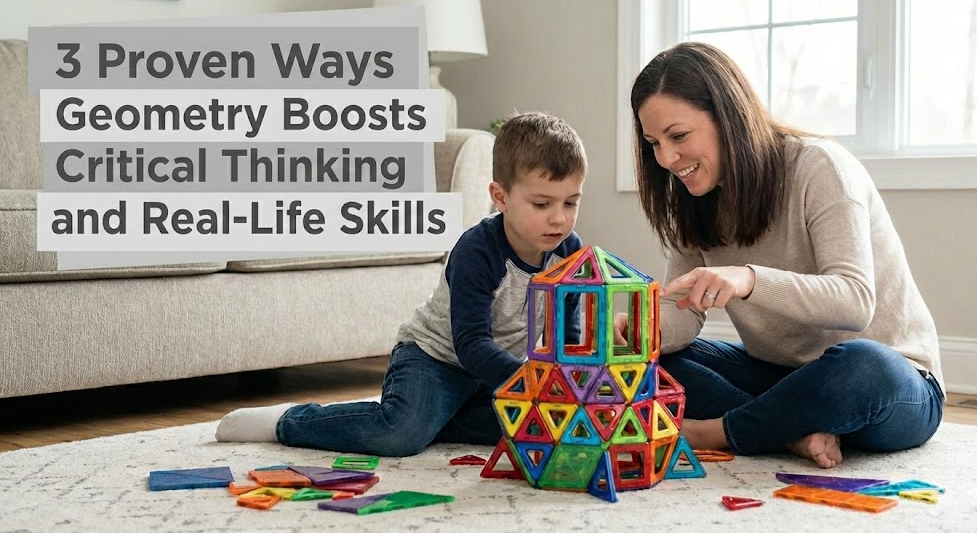
In four weeks of focused, playful geometry practice, your child can show clearer spatial reasoning, make fewer careless errors, and explain solutions aloud. Geometry strengthens logical steps, visual reasoning, and everyday problem-solving that schools prize.
Let's look at 3 activities that are ready to try, have clear signs to measure progress, and are simple next steps for steady growth. This guide covers what geometry builds (thinking skills that transfer to life), troubleshooting common obstacles, and when to seek extra support.
Why Geometry Matters
Geometry develops four core cognitive gains: spatial reasoning, proof-style logic, pattern recognition, and precision in communication. These skills directly impact how children navigate spaces, solve multi-step problems, and articulate their thinking.
Transferable benefits your child gains:
Better map reading and navigation skills
Improved error-checking in multi-step math problems
Clearer oral explanations during homework sessions
Here are three targeted, low-prep activities that build these exact skills.
3 Practical Geometry Activities Parents Can Try Tonight
Activity 1—"Shape Detective": Build Visual Classification & Vocabulary
Materials: Index cards, marker, small household objects
Steps:
• Label cards with shape names (circle, cylinder, prism, sphere)
• Hide 12 objects around one room
• Your child must find the objects, sort by shape, and explain at least one choice
• You ask: "Why is this a cylinder?"
What to watch for: Your child uses shape names and gives one reason ("because it has parallel circular faces").
Success indicators: Your child sorts 12 objects with 90% correct labels OR explains reasoning for 8/12 choices. Achieve clear labeling and one explanation within two sessions.
Activity 2—"Measure & Estimate Challenge": Strengthen Spatial Estimation
Materials: Measuring tape or ruler, sticky notes
Steps:
• Pick three household items (book, table, doorway)
• Your child estimates one dimension before measuring
• You record the actual measurement and error on a sticky note
• Repeat daily for one week with different items
What to watch for: Improvement in estimation error over three trials.
Success indicators: Reduce average error to within 15% of true length in one week. Alternative goal: Name the correct nearest inch for 3/4 items.
Transfer cue: Ask your child to estimate whether furniture fits through doorways or how much wrapping paper covers a gift box.
Activity 3—"Reason-Aloud Proofs" (Upper Elementary+): Develop Logical Sequencing
Materials: 3-4 simple geometry problems or diagram cards
Steps:
• Present a triangle with two equal sides marked
• Ask: "What can you tell me about the angles?"
• You can prompt: "What do you notice first? What comes next?"
• Your child explains step-by-step reasoning
What to watch for: Whether your child uses stepwise reasoning, linking one fact to the next.
Success indicators: Your child completes a stepwise explanation without prompts twice in a session. Demonstrate one independent proof-style explanation within three sessions.
How to Weave Geometry into Everyday Life: Practical Integration and Troubleshooting
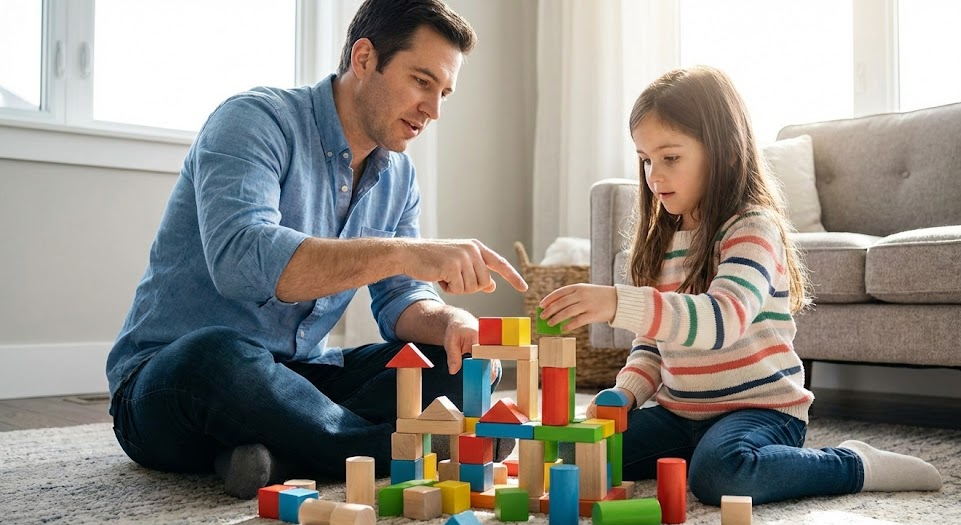
Topic-specific integration opportunities:
Home projects: Ask your child to sketch a bookshelf plan and compute shelf area.
Travel logistics: Have them choose the best table layout for a birthday party using area and perimeter reasoning.
Visual culture: Identify geometry in architecture during neighborhood walks. Point out triangles in roof trusses or symmetry in building facades.
Troubleshooting common issues:
When children hesitate, use simpler prompts and celebrate partial descriptions. If they rely too heavily on formulas, prompt "Why does this work?" rather than "Which formula?"
How to Measure Progress and When to Seek More Support
Practical measurement checklist:
Accuracy target: Correctly apply shape names and measurements in 8/10 tasks
Confidence target: Your child explains reasoning aloud for 3 different problems without prompting
Transfer target: Applies geometry idea in real task (plans shelf layout) within 3 weeks
If progress stalls after 6-8 weeks or your child shows persistent anxiety around geometry tasks, consider structured online support.
Quick Insight: One-Minute Geometry Checkpoint
Ask your child to name 3 shapes they see right now and give one reason why each is that shape. This boosts observation and explanation skills instantly.
Using Geometry to Build Confident Thinkers
You already have simple, high-impact tools to strengthen your child's reasoning. Start with the Shape Detective game tonight or try the one-minute checkpoint during dinner.
Within days, expect clearer explanations and fewer careless errors. Your child will show more willingness to tackle geometry challenges. Long-term, you're building confident learners who use spatial thinking in academics and everyday life.
For guided practice and personalized support tailored to your child's needs, explore a demo class to see how structured learning accelerates these skills.
Was this article helpful?
Your feedback helps us write better content