
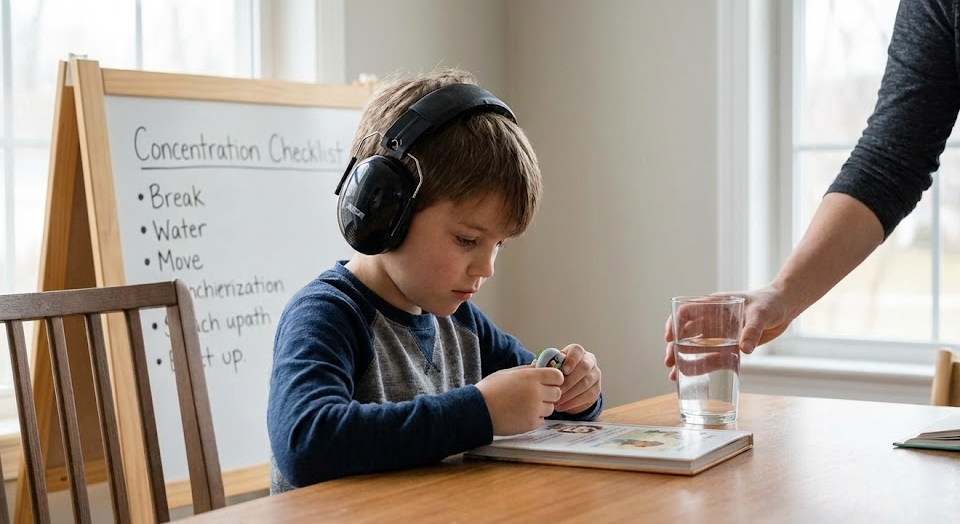
You sit at the kitchen table. Your child says, "I can't focus." The evening dissolves into frustration. This scenario is common. Many children show sudden dips in attention with no obvious cause.
This article identifies why kids struggle to concentrate, gives you a clear step-by-step fix sequence, and offers short activities you can try tonight. You will know what to look for and what to do about it.
Quick Reality Check: Is This a Distraction or a Persistent Problem?
Not every attention lapse signals a deeper issue. Your child may lose focus occasionally, especially when tired or bored.
Watch for these red flags:
Consistent homework avoidance lasting more than two weeks
Sudden drop in accuracy or completion rates
Major behavior shift (withdrawal, irritability, resistance)
When to seek help: If your child struggles to concentrate for 4-6 weeks despite changes at home, you may want to consult your pediatrician.
Understanding the "why" helps you pick the right fix for your child.
What Are the Common Causes for Low Focus in Math?

Your kid may struggle to concentrate for different reasons. Identifying the cause guides your next steps.
A. Physical and Biological Factors
What you may notice:
Sleep deficit (less than 9-11 hours)
Hunger or dehydration during homework
Vision or hearing issues
Undiagnosed ADHD signs (impulsivity, fidgeting)
Action you can take: Track sleep hours for 7 days. Note changes in your child's alertness patterns.
B. Emotional and Mental Load
What you may observe:
Stress from school, friendships, or family changes
Anxiety that shows up as task avoidance
Perfectionism that prevents starting
Overwhelm from too many activities
Action you can take: Ask one calm question before starting work: "What's on your mind today?"
C. Environment and Task Design
What you might see:
Overstimulating spaces (TV on, cluttered desk)
Unclear instructions
Tasks that are too hard or too easy
Action you can take: Simplify tasks into 2-3 clear steps. Remove visual clutter from your child's work area.
When children are struggling to focus, the cause often involves a combination of these factors.
A Step-by-Step Fix Plan You Can Use Tonight
You can follow these five steps to create immediate improvement when your kid struggles to concentrate.
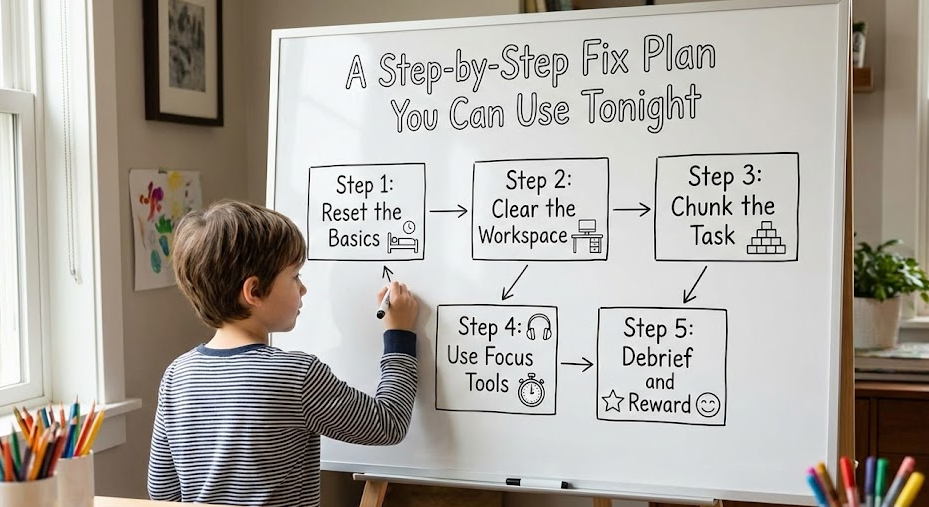
Step 1: Reset the Basics
Create a 30-minute wind-down before homework. No screens. Offer your child water and a light snack.
Success indicator: Your child begins the task within 5 minutes of sitting down.
Step 2: Clear the Workspace
Remove three visible distractions. Put phones in another room.
Success indicator: Your child stays at the desk for a continuous 15-minute block.
Step 3: Chunk the Task
Break the assignment into 10-minute segments. Example: "Solve 5 problems, then take a 2-minute break."
Success indicator: Your child completes 4 out of 5 items correctly or self-corrects 2 errors without prompting.
Step 4: Use Focus Tools
Use a visual timer plus a small fidget (used only during focus time).
Success indicator: Your child asks to use these tools independently next time.
Step 5: Debrief and Reward
Spend 2 minutes reflecting. Ask: "What helped you focus today?" Give a small reward (choice of next activity).
Success indicator: Your child identifies one specific strategy that helped.
You can use these steps consistently for one week to see measurable changes in your child's attention.

Simple Activities You Can Try to Strengthen Attention
You may use these activities to build your child's focus capacity over time.
Activity A: 2-Minute Focus Sprint
Materials: Kitchen timer, short list of problems or a reading paragraph
What you can do:
Set the timer for 2 minutes
Your child works without interruption
You note if they stop early
Success metric: Your child completes the full 2 minutes with 80% accuracy.
Adaptation: Younger children can start with 1-minute sprints. Older children can extend to 5-10 minutes.
Activity B: Predict and Check
What you can try:
Ask: "How many problems will you finish in 6 minutes?"
Your child predicts, works, then compares
Success metric: Your child's prediction lands within 1 of actual completion.
Day-to-Day Integration
You can incorporate attention practice into existing routines:
Run a 2-minute focus sprint before homework
Practice sustained attention during family board games
Use "predict and check" when packing or sorting
These routines help your child turn struggling to concentrate and focus into a skill they build daily.
Start Building Better Focus Tonight
You now know why kids struggle to concentrate and have a concrete plan you can use. Choose one cause that matches what you observe in your child. You can apply the five-step fix tonight.
Run the 2-minute focus sprint before starting. Track results for one week. You will see your child's attention span lengthen and independence grow.
Want expert support for building your child's focus and math confidence? Explore a demo class where instructors strengthen concentration while teaching math skills.
Was this article helpful?
Your feedback helps us write better content