Remember when math for your child was just adding and subtracting? Sixth grade flips the script. Suddenly, numbers start telling stories. For parents, this is also a chance to make math exciting and relevant. Here is what do 6th graders learn in math and how you can help make it fun and meaningful:
Numbers and Operations
Fractions and decimals: Add, subtract, multiply, and divide fractions and decimals, including converting between the two when needed
Rational numbers: Work confidently with integers, fractions, and repeating/terminating decimals, understanding how they relate to one another
Integers: Use positive and negative numbers in real-life contexts like temperatures, finances, or elevations
Theory of Numbers: Learn about factors, multiples, prime and composite numbers, HCF & LCM, and their interrelations
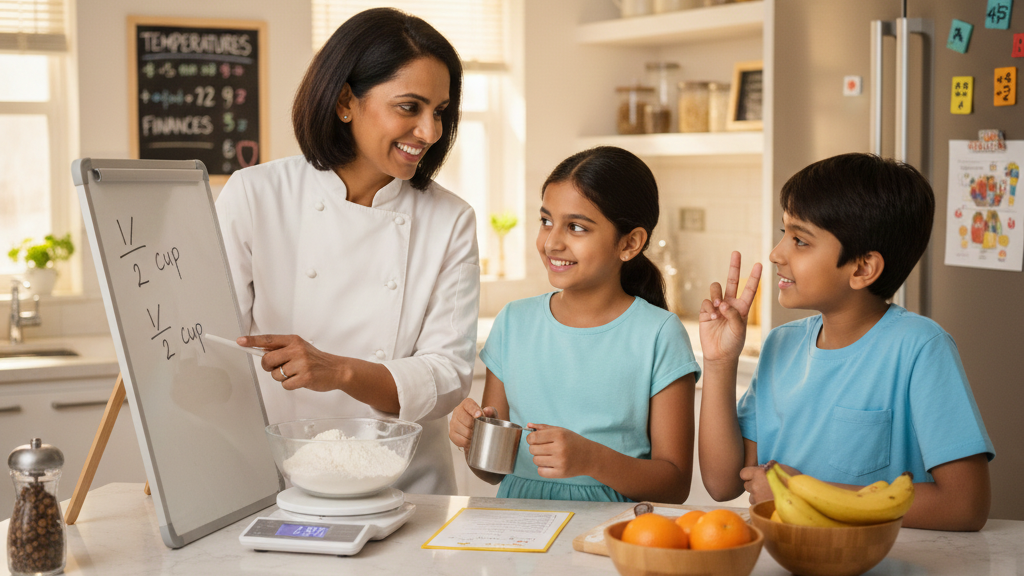
💡 Insight: Turn everyday activities into mini math lessons. For example, while cooking, ask your child to double or halve a recipe, convert cups to tablespoons, or calculate the fraction of ingredients left. This helps them see fractions, decimals, and negative numbers in context. |
Ratios and Proportional Reasoning
Ratios and rates: Solve problems using unit rates and percentages, such as comparing prices, speed, or quantities
Proportional relationships: Apply ratios to real-world problems like scaling recipes, resizing drawings, or dividing resources fairly

💡 Insight: Challenge your child to compare prices when shopping, like figuring out which pack of snacks is the better deal. Or, ask them to adjust a recipe for more or fewer servings. This makes ratios and proportional reasoning tangible and practical. |
Expressions and Equations
Algebraic expressions: Write, simplify, and evaluate expressions using letters to represent numbers
Equations and inequalities: Solve simple equations and inequalities, learning to balance both sides and understand unknown values
Number properties: Use distributive, associative, and commutative properties to make calculations faster and more accurate
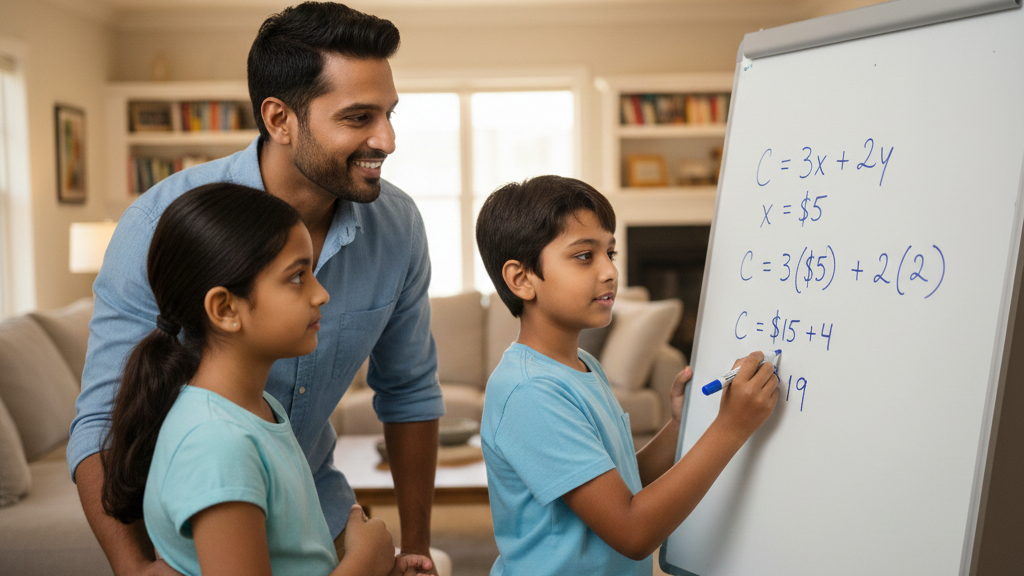
💡 Insight: Turn abstract algebra into a “solve it together” game. Give your child a small problem, like calculating the cost of multiple items with a formula, and ask them to explain each step. Explaining their reasoning reinforces understanding and builds confidence. |
Geometry
Area, surface area, and volume: Calculate for both 2D shapes (like rectangles and triangles) and 3D objects (like boxes and cylinders)
Coordinate plane: Plot points, identify shapes, and understand positions in all four quadrants, linking math to maps or navigation

💡Insight: Make geometry hands-on. Let your child measure rooms, furniture, or boxes to calculate area and volume. Even drawing a simple map of their room on graph paper and plotting points for furniture helps them understand the coordinate plane and spatial relationships. |
Statistics and Data
Statistical measures: Calculate mean, median, mode, and range to summarize sets of numbers
Data displays: Create and interpret dot plots, histograms, tables, and charts to spot patterns and trends
Probability: Explore basic probability by predicting outcomes of simple events and experiments, linking chance to everyday situations like rolling dice or drawing cards
Introduction to AI and ML: Learn basics of AI, machine learning models, data visualization, types of graphs, and linear regression
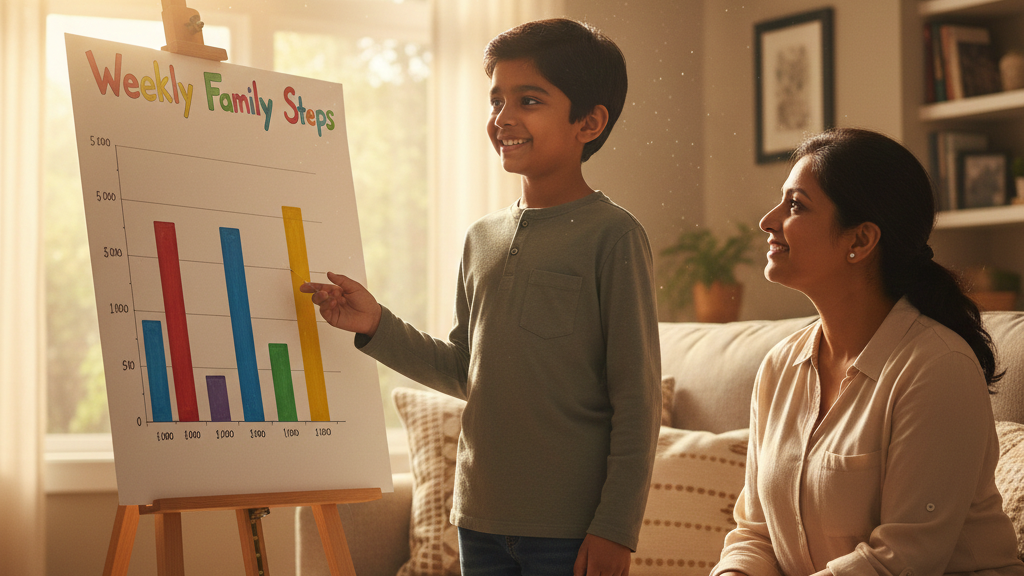
💡Insight: Turn daily data into a small project. Track family steps, screen time, or the weather for a week, and have your child create charts or graphs. Then discuss patterns and trends together. |
Advanced Problem Solving
Word problems: Apply multiple math concepts to solve multi-step problems
Critical thinking: Use logical reasoning to break down complex scenarios, decide which operations to use, and check answers
Speed math: Step addition, subtraction, multiplication, cross multiplication, and word problems
Language of math: Binary numbers, Boolean algebra, truth tables, and logic gates
World of finance: Basics of money, saving, earning, banking, and goal setting
World of passwords: Cryptography, encryption/decryption, and public/private keys
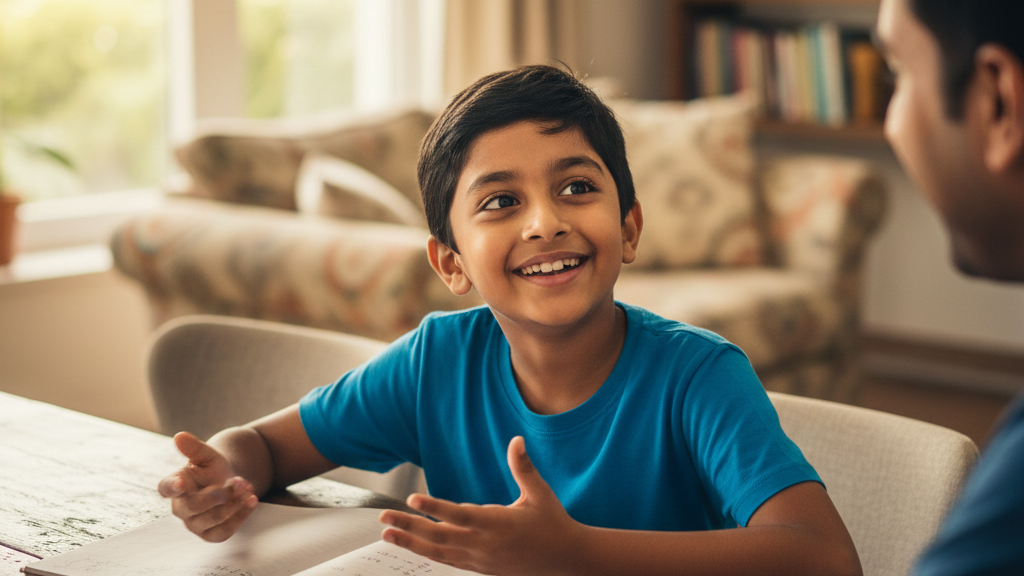
💡Insight: Encourage your child to talk through each step aloud when solving word problems. Verbalizing reasoning builds understanding and confidence. |
Helping Your 6th Grader Love Math
From figuring out how much paint to mix for a project to comparing prices at the store, your child is learning skills in 6th grade that they will use every day. By supporting their learning with hands-on activities, real-life examples, and thoughtful questions, you can turn challenges into “aha” moments and build both confidence and curiosity.
If you want your child to get extra support and practice in a fun, interactive way, Bhanzu makes learning math engaging and practical. It helps your child connect geometry to music through rhythm, beats, and time signatures. Your kid also gets to learn basics of AI and machine learning models. Book a demo today and see how Bhanzu can make sixth-grade math come alive for your child.
Was this article helpful?
Your feedback helps us write better content
![160+ Awesome Math Riddles for Kids [With Answers]](https://static.bhanzu.com/blog-images/math-riddles-for-kids/1777622428332-d4899bbe.webp)