
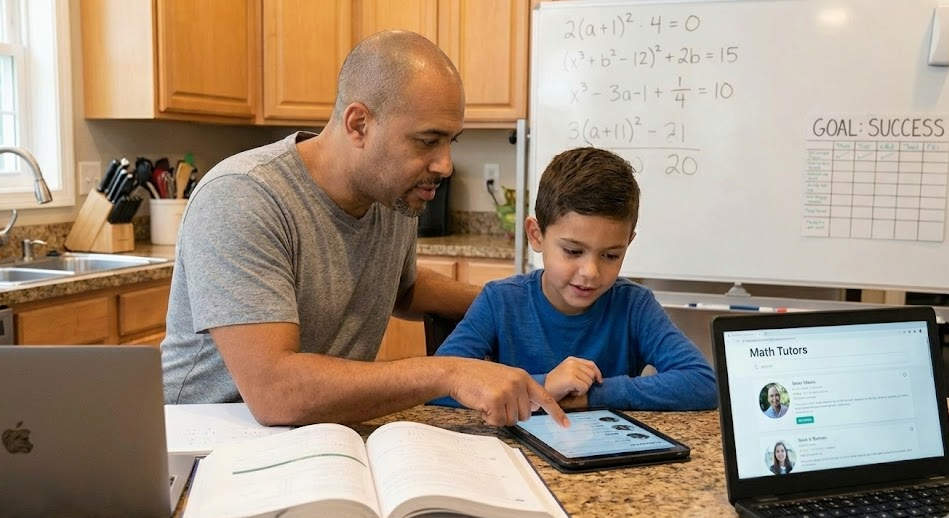
Your teen shuts their laptop after a grueling algebra test and says, "I'll never get this."
You feel concerned, pressed for time, and unsure how to help.
Hiring a tutor seems like the answer, but which one will actually make a difference?
This guide gives practical, step-by-step criteria to choose a high school math tutor (online or local) so you can feel confident the tutor will strengthen understanding, improve homework independence, and deliver measurable progress.
A 5-Step Guide to Finding and Evaluating the Right Tutor
You can follow these steps to select a tutor who delivers measurable results.
Step 1: Prioritize Key Differentiators When Comparing Tutors
Credentials matter (degree, certifications), but evidence of results matters more. You could look for student progress examples, pre and post assessments, or sample lesson outcomes.
You might ask potential tutors: "Can you share an example where a student improved in a specific area?" Strong tutors provide concrete details like "Student raised quiz scores from 65% to 85% over six weeks."
Step 2: Match Teaching Style to Your Teen's Learning Needs
Math tutoring for high school students works best when the teaching style matches the learning gap.
Students who ask "why does this work?" need concept-first tutoring. Students who understand concepts but need speed benefit from practice-heavy approaches with timed drills.
Quick assessment: Does your child ask "why" during homework, or do they get stuck on which steps to use? The first needs conceptual coaching. The second needs procedural practice.
Step 3: Weigh Practical Differences Between Online and Local Tutors
Both formats work well, but each offers distinct advantages depending on your family's needs and your teen's learning preferences.
Factor | Online Tutoring | Local Tutoring |
|---|---|---|
Convenience | No travel time; flexible scheduling | Face-to-face interaction |
Platform Tools | Screen sharing, digital whiteboard | Physical manipulatives, paperwork |
Subject Specialists | Access nationwide for advanced courses | Limited to local availability |
A high school math tutor online often provides broader subject match for higher-level courses like AP Calculus BC, where local specialists may be scarce.
Step 4: Vet and Trial a Tutor with Clear Metrics
We recommend by starting with preparing a baseline. You can gather recent homework and note 2 to 3 recurring errors. Example: "5 out of 10 problems correct; needs help with quadratic factoring."
Next, you might consider asking targeted interview questions like:
"How do you diagnose gaps in understanding?"
"Can you show me a 20-minute sample plan for a weak topic?"
"How will you measure progress?"
"Can you share one parent and one student reference?"
Then, you could run a structured trial session. Format the trial as a 45-minute session: 10 minutes diagnostic, 25 minutes targeted teaching, 10 minutes parent debrief.
Finally, evaluate after 3 to 4 sessions. You can use transfer measurement: "Student completes similar homework with 30% fewer hints" or "Self-corrects 2 errors independently."
Step 5: Understand Costs, Scheduling, and When to Switch
Once you've found a promising tutor, you'll need to consider practical factors like budget, session timing, and progress monitoring.
A. Cost Considerations
Typical range for high school math tutoring: $40 to $80 per hour for general tutors; specialists for AP courses may charge $80 to $150 per hour. You might factor in frequency, materials, and platform fees for online math tutoring for high school.
B. Scheduling Tips
You could pick a consistent weekly slot 48 to 72 hours before big quizzes. For AP or honors courses, you might consider twice-weekly 30 to 45 minute sessions.
C. Red Flags That Mean You Might Switch Tutors
No measurable progress after 6 sessions
Tutor avoids showing lesson plans or assessments
Student expresses persistent dread or disengagement
When you see these signs, you can revisit your baseline metrics and consider finding a different tutor.
Your Tutor Selection Action Plan Starts Now
You could run a 20-minute baseline assessment this week by pulling out recent homework or a practice test. You might write down 2 to 3 specific error patterns your teen makes repeatedly. Then you can use the interview questions from Step 4 to book a trial session with a tutor who directly addresses those gaps.
The right high school math tutor transforms your teen's relationship with math within weeks. You'll notice the moment when your teen opens their homework without sighing first, or when they attempt a problem before immediately asking for help.
To explore structured support taught by experienced high school math tutors, you could consider booking a demo class for guided, personalized instruction.
Was this article helpful?
Your feedback helps us write better content