
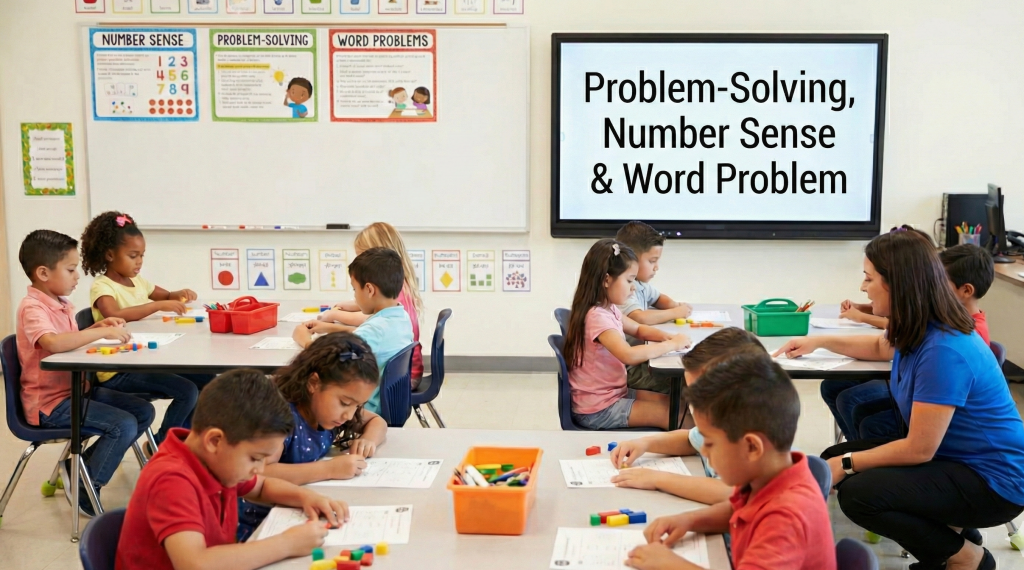
Navigating your child’s Individualized Education Program (IEP) math objectives can feel complex at first. Those big phrases like “demonstrates improved fluency” or “uses a problem-solving strategy” may sound technical, but they simply describe skills your child can build through everyday activities. This guide will show you how.
We’ll break down common math IEP goals and objectives examples for number sense, problem-solving, and word problems into simple, playful steps you can try at home. Every activity boosts confidence, and every success is worth celebrating. You and your child make an amazing team! 💪📚
🔢 1. Helping Your Child Understand Numbers (The "Number Sense" Goal)
This goal is all about making sure your child understands what numbers mean and how they relate to the world.
✅ Quick Action: Place Value
The Goal: Knowing that the position of a digit matters (e.g., the 4 in 45 is different from the 4 in 540).
What to do tonight: Play the "What's It Worth?" game.
Write a four-digit number (like 3,791) on a paper.
Point to the 7. Ask: "Is this worth just 7, or is it worth 70, 700, or 7,000?"
The answer (700) is the value! Repeat with other digits.
Why this works:
Carrying and borrowing only work when a child understands place value. When children clearly know what each digit represents, multi-digit math stops feeling confusing and starts making sense step by step.
✅ Quick Action: Ordering and Comparing
The Goal: Putting numbers in the right sequence (least to greatest).
What to do tonight: Use the Car License Plate Challenge.
As you drive, point out three license plates.
Ask your child: "Which of those three numbers is the smallest? Which is the biggest?"
This is quick practice for comparing multiple numbers.
🧠 2. Helping Your Child Solve Problems (The "Problem-Solving" Goal)
This is about teaching your child to stop and think before jumping to a calculation. These are key math problem solving iep goals and objectives examples.
✅ Quick Action: Planning the Attack
The Goal: Selecting the right strategy (e.g., drawing a picture, making a list).
What to do tonight: Introduce the "No Calculation First" Rule.
Read a homework problem. Before they touch a pencil, ask: "If you were drawing this out, what would it look like?"
The focus is on the visual plan. If they can explain the plan, the solving comes easier.
✅ Quick Action: Checking the Work
The Goal: Using the opposite math operation to prove their answer is correct.
What to do tonight: Use the "Be the Judge" strategy.
If they subtract to get an answer (e.g., $10 - 3 = 7$), tell them: "I don't believe you! Show me with addition!"
They must then prove it ($7 + 3 = 10$). This makes checking a fun challenge, not a chore.
📖 3. Helping Your Child With Word Problems (The "Translation" Goal)
Word problems are tough because they mix reading with math. We need to help your child become a translator.
✅ Quick Action: Spotting the Keywords
The Goal: Finding the words that tell them which math operation to use.
What to do tonight: Create a Keyword Secret Code.
Make four small cards together. This becomes their at-home cheat sheet for all word problems.• Write + (addition) on one card
Under it, write: total, in all, altogether• Write − (subtraction) on another card
Under it, write: left, remaining, difference• Write × (multiplication) on a third card
Under it, write: times, groups of• Write ÷ (division) on the last card
Under it, write: share equally, equal groups, split
✅ Quick Action: Removing the Noise
The Goal: Ignoring unnecessary information in the problem.
What to do tonight: Play "Fact vs. Fluff".
Read a problem out loud that includes a useless detail (e.g., "Sarah had 10 stickers. She got 5 new ones. Her dog is brown. How many stickers does she have now?").
Ask them to shout out the detail that is "fluff" and then read back only the facts needed to solve the problem (10 and 5).
⭐ Your Next Step
Pick one quick action from the list above and try it today. Just one! Even five minutes of focused, fun practice can make a huge difference in supporting their IEP math objectives. Celebrate the small wins along the way and notice how your child’s confidence grows with each step. Keep it light, keep it fun, and remember that every little effort adds up to big progress.
For extra support and engaging math practice, check out Bhanzu, where your child can explore interactive exercises and games designed to strengthen skills and build confidence. It’s a fun way to turn learning into a daily habit! Book a demo now to get started.
Was this article helpful?
Your feedback helps us write better content