
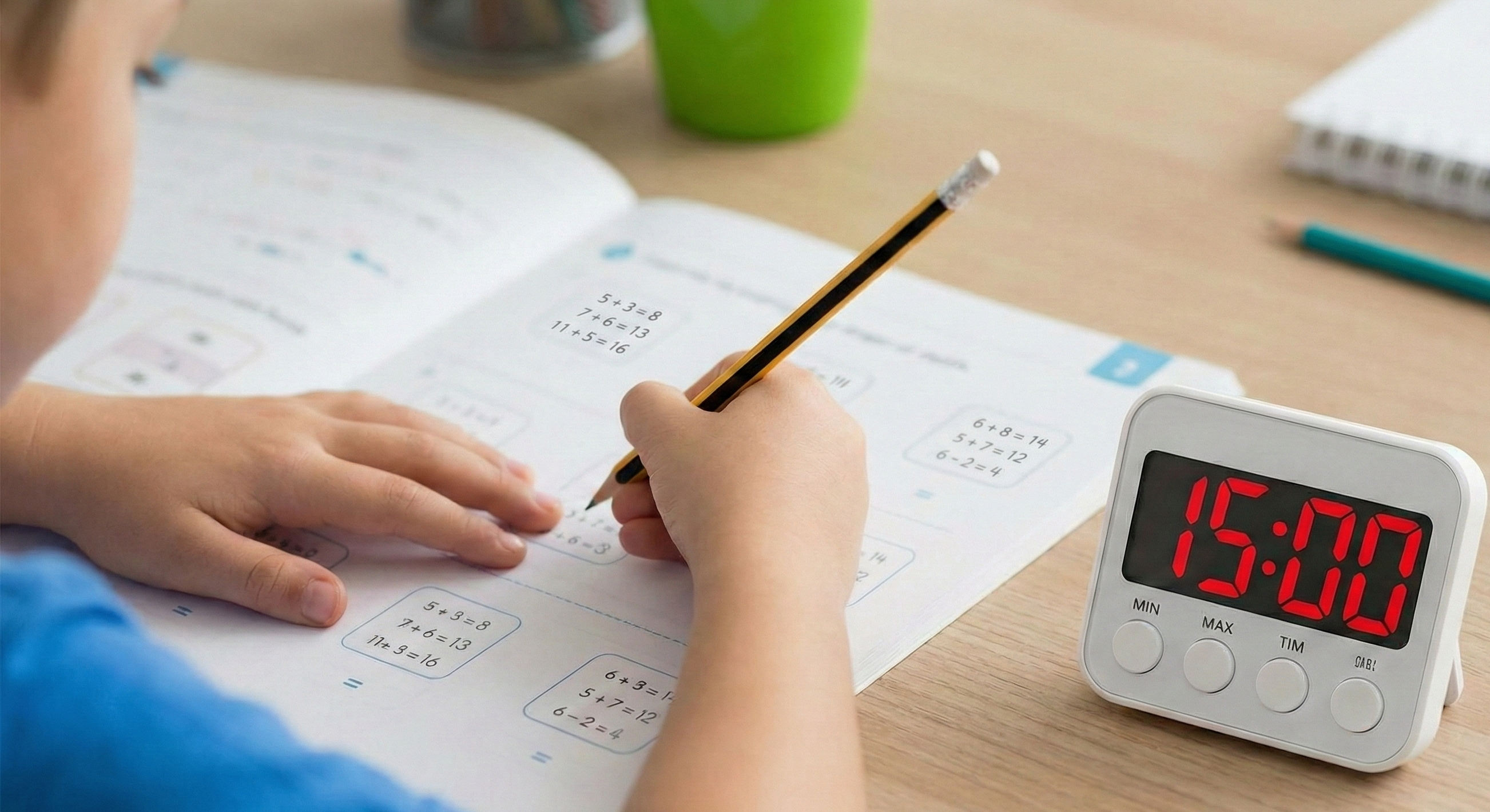
Your child sits at their desk for an hour. The math worksheet remains half-finished. They fidget, stare out the window, and ask for water three times.
You wonder if concentration is something you can actually improve or if your child is simply wired this way. The truth is that concentration is a skill you can strengthen with the right strategies, especially during subjects like math that demand sustained attention.
This article gives you 9 research-backed tips on how to concentrate better.
9 Practical Ways to Improve Concentration
Many of these strategies work particularly well during math homework, problem-solving, or revision sessions.
1. Create a Distraction-Free Zone
Remove phones, tablets, and unnecessary items from your child's workspace.
Why it works: Visible distractions consume cognitive resources even when ignored, making it harder to hold numbers, calculation steps, or formulas in working memory.
How to measure: Time how long your child works without getting up. Aim for 15-minute blocks spent solving math problems without interruption.
2. Use the Pomodoro Technique
Set a timer for 20 minutes. Your child works without interruption, then takes a 5-minute break.
Why it works: The brain maintains focus better in short bursts, which is ideal for completing a set of 10 multiplication problems or mastering one concept at a time.
How to measure: Track how many 20-minute sessions your child completes and how many math problems they finish accurately in each session.
3. Prioritize Sleep
Establish a consistent bedtime that allows 9 to 11 hours of sleep. Create a 30-minute wind-down routine without screens.
Why it works: Sleep deprivation impairs the prefrontal cortex. Poor sleep reduces concentration, directly affecting calculation speed and error rates in math.
How to measure: Track your child's morning alertness after one week and note whether math work feels less tiring.
4. Support the Brain with the Right Nutrition
Offer a protein-rich snack and water 15 minutes before homework starts. Avoid sugary snacks.
Why it works: Stable blood sugar and hydration directly affect concentration capacity, which is critical for logical thinking and numerical reasoning during math practice.
How to measure: Note whether your child complains less about difficulty focusing or completes their math homework faster.
5. Teach Single-Tasking
Your child completes one subject fully before starting another. Finish all math problems before moving to reading or writing.
Why it works: Multitasking reduces efficiency. Each task switch wastes mental energy needed for calculations and step-by-step problem solving.
How to measure: Time how long it takes to complete a math worksheet with single-tasking versus switching between subjects.
6. Use Visual Timers
Place a visual countdown timer where your child can see it during homework.
Why it works: Visual timers make abstract time concrete, similar to how number lines make abstract quantities visible in math.
How to measure: Your child works the full timed period without asking "how much time is left?" and completes more problems per session.
7. Practice Mindful Breathing
Before starting work, your child takes 10 slow breaths (5 counts in, 5 counts out).
Why it works: Deep breathing reduces stress hormones that interfere with concentration, especially useful before tackling challenging multi-step math problems or timed tests.
How to measure: Compare how quickly your child settles into work and starts solving problems with versus without the breathing routine.
8. Break Tasks Into Micro-Goals
Set specific micro-goals: "solve 5 addition problems," "complete one word problem," "finish the fractions section."
Why it works: Large assignments overwhelm working memory. Small goals create achievable checkpoints, mirroring how math concepts are learned incrementally.
How to measure: Count how many micro-goals your child completes per session. Track improvement over one week.
9. Reward Focus, Not Just Completion
Praise your child when they maintain focus for a target time, even if they don't finish everything.
Why it works: Rewarding the behavior (sustained attention) reinforces the skill you want to build, creating better long-term concentration habits.
How to measure: Track how often your child returns to focus independently after distractions, or how many consecutive problems they complete without losing attention.
Start Improving Your Child's Concentration Tonight
Small changes today can unlock remarkable focus tomorrow. Try introducing these strategies during your child’s math homework and observe how clarity replaces distraction, and confidence replaces careless errors. Over a week, you’ll begin to see which habits truly support your child’s natural ability to concentrate and think independently.
When focus is nurtured alongside structured math learning, children don’t just solve problems better: they pick up on the right approach to learning. If you’d like expert support in building these focus skills through a thoughtfully designed math journey, explore a Bhanzu demo class and take the first step toward more confident, focused learning.

Was this article helpful?
Your feedback helps us write better content