
Trying to build your child's math skills early often feels like a basic part of parenting. Abacus math is one of the most popular places to start — and for good reason. It's hands-on, visual, and gives children a concrete way to understand numbers before abstract thinking kicks in.
But here's a question most abacus articles don't ask: what happens after the abacus? What does the next level of math fluency actually look like — and how do you get there?
This article covers how abacus math works, what it genuinely builds in a child's mind, and where its limits are. It also looks at how programs like Bhanzu take the mental math foundation that abacus creates and push it further — to a point where children calculate rapidly without any tool at all.
What is Abacus?
An abacus is one of the oldest tools used to perform calculations such as addition, subtraction, multiplication, and division. It consists of a frame with rods and movable beads that slide back and forth to represent numbers.
Each bead’s position represents a place value such as units, tens, or hundreds. Moving these beads shows how numbers are formed and changed during calculations.
This visual approach makes abacus maths easier to understand. Instead of sticking with pen-and-paper, abacus maths helps picture numbers and makes problem-solving interactive.
Origins and History of the Abacus
Calling a tool of beads an ancient calculator makes you wonder how ancient it could be. Well, abacus maths began thousands of years ago in ancient Babylon. Historians have the abacus dating back to 2400 BC, with early versions having stones for beads.
But it didn't end there; abacus math soon spread across cultures, like China in 200BC and Japan in the 1400s. Over time, it became a popular tool for bookkeeping in Europe and the Middle East.
Before the digital era, the abacus was a quick and reliable tool for trade and accounting. Today, it's become a popular education tool that stands out in the mental math space.
How the Abacus Represents Numbers
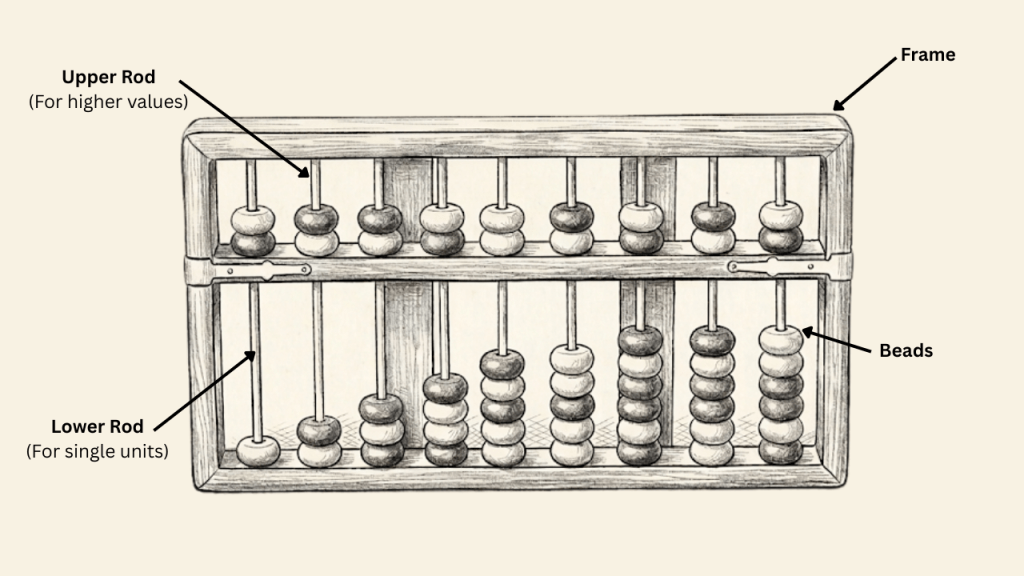
When your child looks at the abacus, it'll look like a puzzling toy. Understanding how it crunches numbers starts with how each bead represents them. Let's break it down into four parts:
Every bead: Each bead represents a numerical value based on the rod it sits on. The rod determines the place value, such as units, tens, or hundreds.
Lower rod of beads: The lower section usually has multiple beads, and each bead represents one unit of that rod’s place value.
Upper rod of beads: The upper section typically has one or two beads that represent higher values, depending on the type of abacus.
Movement: A bead only counts when it is moved toward the central beam, making it “active” in the number being represented.
Types of Abacus Used Around the World
Tracing the journey that abacus math has taken can be quite fascinating. Especially when your child learns that the abacus travelled across several countries before becoming popular worldwide.
All while strengthening arithmetic agility, one mind at a time.
Chinese Suanpan
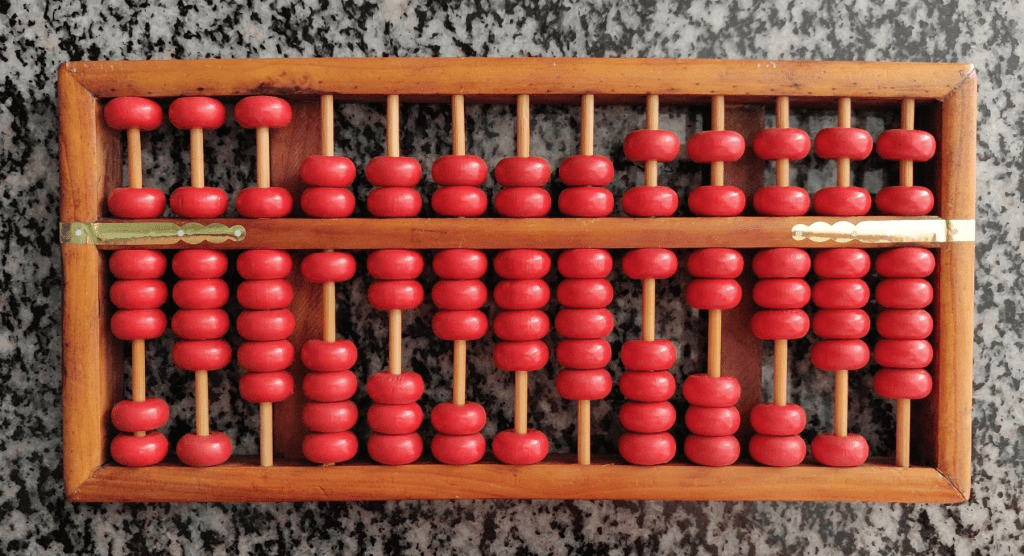
The Suanpan is the traditional Chinese abacus and one of the earliest forms still in use today. It typically has two beads on the upper deck and five beads on the lower deck for each rod.
This design allows users to perform both decimal and hexadecimal calculations. Because of its versatility, the Suanpan was widely used by merchants and traders for centuries.
Japanese Soroban
The Soroban is a simplified version of the Chinese abacus developed in Japan. It has one bead on the upper deck and four beads on the lower deck.
This streamlined structure makes calculations faster and easier to learn, which is why it is the most commonly used tool in modern abacus maths programs for children.
Russian Schoty
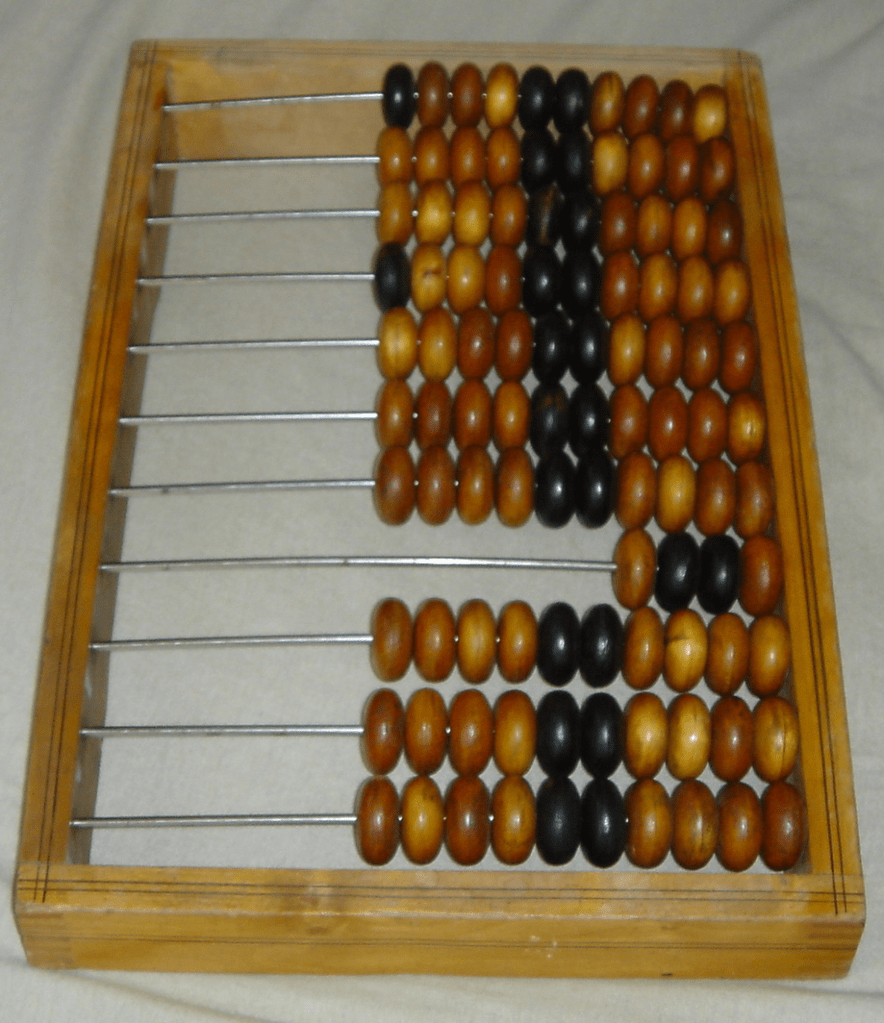
The Schoty is a horizontal abacus used in Russia. Unlike the Soroban or Suanpan, its beads slide from left to right across wires rather than vertically.
It is mainly used for simple arithmetic operations such as addition and subtraction, and was historically common in accounting.
How Abacus Math Works (Step-by-Step)
The ultimate goal of abacus math is to be able to perform those calculations without any tool. Before jumping to the mental abacus, let's go through how to use the tool.
Understanding the Basic Structure
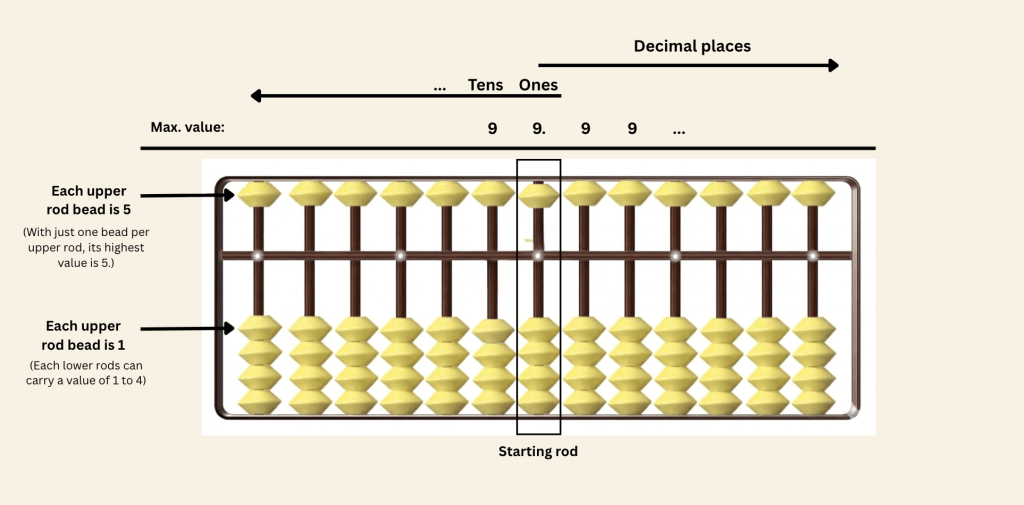
First off, your kid must know how to use the beads to represent the number they've got in mind. Here are the basic positions to understand on an abacus:
Place value: The starting rod your child chooses represents the ones place value. Anything to its left will move up (tens, hundreds, etc.), and its right will be decimals (.1, .01, etc.).
Lower rod: Each bead here represents a value of one and must be raised towards the separation bar to be counted. If you raise three beads in the starting lower rod, that's 3, and three in the tens lower rod is 30.
Upper frame: Beads here are valued at five and counted when moved down towards the separation bar. Pushing down one bead in the hundreds upper rod is 500.
Finger placement: To move beads efficiently, use the index finger for upper beads and the thumb for lower beads.
Problem: Show the number 15 on your abacus
Rules and tips before arithmetic enters:
Beginners are advised to keep their hands on adjacent rods to avoid place-value mix-ups.
To align with how we read, abacus calculations start with the leftmost (highest) place value and move right. Since it's the opposite of traditional math, it's key to relearn.
Abacus math uses a complement system to move beads more clearly and quickly. These 34 formulas are about which numbers pair together (friend pairs) to make calculations easier.
Performing Addition
With the structure clear, adding comes down to moving the beads by how much you want. Here are the steps, along with an example of adding 5 + 4:
Set the beads to represent the first number (5). Your kid must begin with your starting rod that represents your ones place value.
Move the beads by the addition number (4) on the same rod. If the rod runs out of beads, carry the value to the next rod.
Read the final bead positions to see the answer. Here, the abacus math shows 9.
Age Group | Abacus Lessons | What’s Involved |
|---|---|---|
4–5 years | Introduction to the abacus | Learning bead movement.Recognizing numbers.Understanding how rods represent place values through simple counting exercises. |
5–6 years | Basic addition and subtraction | Practicing simple calculations on the abacus.Strengthening number recognition and finger coordination. |
6–7 years | Structured abacus calculations | Solving larger addition and subtraction problemsBeginning to visualize bead movements. |
7–8 years | Advanced operations and mental abacus | Introducing multiplication and division.Building on early mental abacus techniques for faster calculations. |
Signs Your Child Is Ready
A child may be ready to start learning abacus math if they:
Recognize basic numbers: They can comfortably identify numbers and understand simple counting.
Show curiosity about numbers: They enjoy counting objects, asking number-related questions, or playing simple math games.
Enjoy puzzles and problem-solving: Activities like pattern games, blocks, or logic puzzles hold their interest.
Can focus for short periods: They are able to sit and concentrate on an activity for about 10–15 minutes at a time.
Is Abacus Math Useful Today?
Yes. Even in a digital world filled with calculators and apps, abacus maths may still offer unique benefits.
Abacus vs Calculator — Which Is Better?
Comparing the two tools depends on what your child is looking for. Here are a few key points to consider:
End-result focus: Calculators deliver answers instantly, while the abacus helps children understand how numbers are built and calculated step by step.
Screen time control: An abacus is a hands-on learning tool that keeps children engaged without adding to their daily screen time.
Learning focus: Abacus training strengthens number sense, memory, and mental calculation skills. Choosing a calculator is often to test approaches or experiments, and to save time in the solving journey.
Abacus vs Vedic Maths
When choosing what's right for your kid, these two approaches are often popular choices. Here's a quick table to clear up their approach.
Aspect | Abacus Math | |
|---|---|---|
Approach | Uses visual calculation with bead movement on an abacus. | Uses mathematical shortcuts and formulas. |
Learning Style | Hands-on and visual, helping children picture numbers and place values. | Rule-based, relying on memorizing calculation techniques. |
Best For | Younger learners are building number sense and visualization skills. | Older students who already understand arithmetic concepts. |
Looking for a method that goes further — without relying on physical tools or memorized formulas? Bhanzu’s approach builds calculation speed through mental visualization and cognitive processing, with no abacus or trick sheets required. It’s a natural next step for children ready to move beyond their first math tools.
How to Teach Kids Abacus Math
The decision to learn the abacus also depends on the learning process. Let's break down the environment, recommended prep work, and expected hiccups to consider.
At Home vs Classrooms
Aspect | Learning at Home | Learning in a Classroom |
|---|---|---|
Learning pace | Flexible pace based on the child’s comfort and interest. | Structured progression with planned lessons. |
Guidance | Parents guide practice using books or online resources. | Trained instructors explain techniques and correct mistakes. |
Practice consistency | Depends on how regularly practice sessions are scheduled. | Regular class schedules help maintain discipline. |
Peer learning | Mostly individual learning. | Children observe peers and stay motivated through group learning. |
Best for | Parents who can guide daily practice and keep sessions engaging. | Children who benefit from structured teaching and teacher feedback. |
Tips for Parents
Incorporate these practices when starting your kid on abacus math:
Start with short sessions: Begin with 10 to 15 minutes of practice to build comfort and avoid overwhelming your child.
Focus on bead movement first: Make sure your child understands how beads move and represent numbers before moving into calculations.
Use repetition to build confidence: Regular practice helps children internalize patterns and formulas used in abacus math.
Encourage mental visualization: Once comfortable, ask your child to imagine the abacus while solving simple problems.
Common Mistakes to Avoid
Watch out for these missteps that often make the learning process much slower and more complex:
Rushing through the basics: Many children struggle later because they move to complex calculations before fully understanding bead positions. Slow down and strengthen the fundamentals first.
Focusing only on speed: Parents often emphasize quick answers, but accuracy and correct technique should come first. Remember, speed develops naturally with practice.
Inconsistent practice routines: Irregular practice makes it harder for children to retain bead movements and formulas. Set a regular practice schedule.
Overloading children with long sessions: Long sessions can reduce interest and concentration. Short, focused practice works better for young learners.
Abacus Maths Activities and Games
Solving problems with abacus math often needs a little gamified stimulation. Here are a few activities to keep the learning effective, fresh, and fun:
Group Challenges: Teachers organize friendly competitions where students solve calculations using abacus methods. These challenges keep learning exciting and encourage participation.
Visual Memory Games: Children are shown a number briefly and then asked to recreate it on the abacus. This activity strengthens memory and visualization skills.
Speed Rounds: Students solve a set of calculations within a short time limit. This helps improve calculation speed and confidence with bead movements.
Number Building: A teacher or parent calls out numbers, and children quickly represent them on the abacus. This reinforces place value and number recognition.
Common Myths About Abacus Math
Choosing abacus math should be based on a clear understanding of what it delivers. Let's clear up a few misconceptions that surround abacus math:
Is not outdated: Modern abacus programs train children to perform complex calculations and eventually solve problems using a mental abacus.
Not just for basic math: While learning begins with addition and subtraction, students gradually move to multiplication, division, and advanced mental calculation techniques.
Doesn't replace school math: The abacus is meant to complement classroom learning, helping children strengthen their understanding of numbers.
Not only about speed: Faster calculation is a result of practice, but the main goal is to build number sense, memory, and concentration.
Not just for young kids: Although many children start early, older learners can also benefit from abacus methods and mental math training.
Building Problem-Solving Foundations and Speed
Abacus math turns numbers into a visual and physical learning experience. Using this one tool builds working memory, concentration, number sense, and early mental math ability. It’s a strong starting point — one that many children outgrow faster than parents expect.
Here’s the key difference worth understanding: abacus-based calculations rely on a physical tool and, often, finger-based counting to track bead positions. Bhanzu works differently. It trains children to calculate mentally — no beads, no fingers, no tool to picture in the mind. Instead, children develop rapid calculation ability through mental visualization and cognitive processing techniques. The result is faster, more flexible math that isn’t tied to any single method or tool.
Thinking of gifting your child a strong mathematical foundation? No tools needed — just brain power. Explore a Bhanzu demo class or even try one of the at-home activities we covered today.
FAQs
What is abacus maths used for?
Abacus maths is used to perform arithmetic operations such as addition, subtraction, multiplication, division, square roots, and cube roots. More importantly, it trains children to visualize numbers and perform calculations mentally, improving concentration, working memory, and overall number sense.
Is abacus math useful?
Yes. Abacus math helps children understand numbers visually and strengthens cognitive skills such as memory, focus, and logical thinking. Many educators consider it a valuable supplementary learning method that supports stronger math performance in school.
How does an abacus help kids?
Abacus training improves mental calculation ability, concentration, and confidence with numbers. It also strengthens working memory and visualization skills, which are important for solving complex problems and learning new concepts.
How Long Does It Take a Child to Learn Abacus Math?
Most structured programs take 1 to 3 years for children to progress from basic abacus use to advanced mental calculation. Progress depends on practice frequency, teaching methods, and the child’s interest.
Can Abacus Math Help with School Exams?
Yes. Students trained in abacus math often solve arithmetic problems faster and with greater accuracy. This can help during timed exams where quick calculations are required.
Is Abacus Math Good for Kids with Learning Disabilities?
The tactile and visual nature of abacus learning can help some children with learning difficulties such as dyscalculia or dyslexia. Representing numbers with physical objects rather than symbols, it may make math concepts easier to understand. Experts recommend consulting an educational specialist before beginning training.
Can kids do mental math with an abacus?
Yes. After practicing with a physical abacus, many children learn to visualize the tool mentally and perform calculations in their head. This technique is called the mental abacus.
At what age should a child learn the abacus?
Children can typically start learning abacus math between 4 and 8 years old, when they are developing basic counting and number recognition skills.
Is Abacus Math the Same as Mental Math?
Not exactly. Abacus math begins with a physical tool where children move beads to represent numbers. Over time, students learn to imagine the abacus mentally and perform calculations without the device. In this way, abacus training becomes a pathway to advanced mental math skills.
Was this article helpful?
Your feedback helps us write better content