
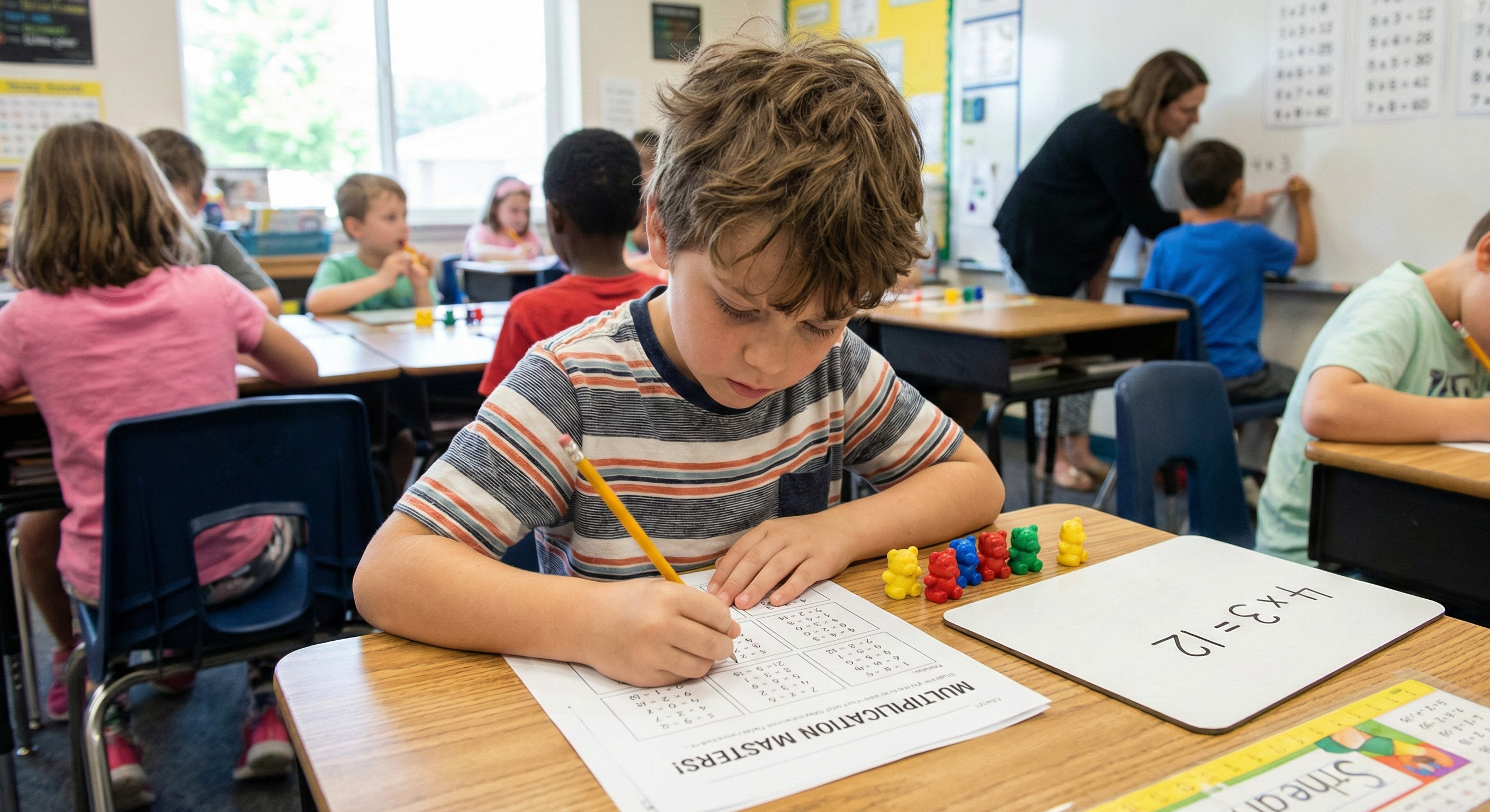
If the word multiplication already makes your child groan, lose focus, or say “I’ll do it later,” it usually means the concept has not fully clicked yet.
For many kids, times tables feel like a long list of numbers they are expected to memorize quickly and perfectly, without really understanding what those numbers mean. That is why parents often keep searching for the best way to teach multiplication or the easiest way to teach multiplication, hoping something finally works.
Let’s look at what actually works in a way that feels natural, stress free, and easy for kids.
Why Rote Learning Does Not Work for Most Kids
Traditional multiplication teaching often looks like this.
Write tables from 1 to 10
Repeat them every day
Take weekly tests
Get corrected or scolded for mistakes
This may work for a small number of children. For most kids, it leads to:
Forgetting tables during exams
Mixing up similar facts like 6 × 7 and 7 × 6
Difficulty solving word problems
Fear or frustration around math
That is because memorization without meaning does not last. Even the best method to teach multiplication will fail if understanding comes last.
The Best Way to Teach Multiplication
If you are looking for the easiest way to teach multiplication without tears or pressure, focus on these ideas instead of drilling tables:
1. Start With Visuals Instead of Tables
Children understand faster when they can see what is happening.
You can use:
Dots
Blocks
Coins
Fingers
Simple drawings
Instead of saying 6 × 4 = 24, show 6 rows of 4 dots and count together.
What kids see | What kids understand |
|---|---|
Groups of objects | Multiplication means grouping |
Arrays | Numbers have structure |
Repeating patterns | Tables are connected |
2. Teach Patterns, Not Isolated Facts
Times tables are full of patterns, and kids enjoy spotting them.
Table | Pattern kids notice |
|---|---|
2 | All answers are even |
5 | Answers end in 0 or 5 |
9 | Digits add up to 9 |
10 | Just add a zero |
When children learn patterns:
Tables feel predictable
Mental load becomes lighter
Confidence grows
3. Let Kids Discover the Answers
Instead of correcting immediately, ask guiding questions.
“How many groups do you see?”
“Can you add it another way?”
“What happens if we double this?”
This approach builds:
Logical thinking
Number sense
Long term memory
Children remember solutions when they figure out themselves.
4. Connect Multiplication to Everyday Life
Multiplication sticks when it feels useful.
Try this at home:
“If one chocolate costs $2, how much do five cost?”
“We need 4 plates with 3 cookies each. How many cookies?”
“You jump 2 steps each time. How far in 6 jumps?”
Suddenly, multiplication is not homework. It is real life.
5. Keep Practice Short and Stress Free
Long worksheets rarely help memory.
Short, consistent practice works better.
Better options include:
Five minute daily challenges
Quick mental math games
Pattern spotting activities
Visual puzzles
Regular practice beats last minute cramming.
6. Use Games to Make Practice Enjoyable
For many families, the best game to learn multiplication tables is one that feels like play, not practice.
Good multiplication games usually involve:
Quick thinking
Visual patterns
Small challenges
Friendly competition
Board games, card games, online math games, and mental math challenges all help children practice without stress. When learning feels like a game, children stay engaged longer and remember more.
What Parents Should Do and Avoid
Sometimes, simple shifts in how we guide our children can change their entire relationship with math. Here is a simple way to know what to encourage and what to avoid.
Helpful habits | Habits to avoid |
|---|---|
Encourage questions | Forcing table recitation |
Praise effort, not just answers | Comparing children |
Use visuals and stories | Timed drills too early |
Allow mistakes | Saying “you are bad at math” |
A Gentle Note for Parents
If you are not sure how to teach multiplication the right way, that is completely normal. Many modern math programs are built around how children actually learn using mental math, visuals, and logical thinking rather than rote memorization. If you would like to see this approach in action, you can book a free demo session with Bhanzu and watch how multiplication becomes clear and enjoyable for kids.
Was this article helpful?
Your feedback helps us write better content